



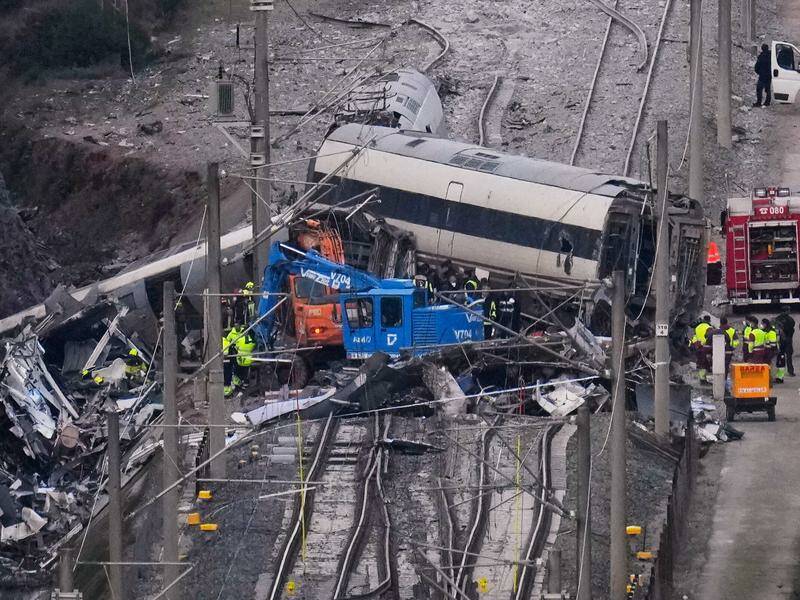
A commuter train derailed near the town of Gelida, approximately 35 minutes from Barcelona, resulting in the death of the driver and injuries to around 20 passengers. This tragic incident occurred after a containment wall collapsed onto the tracks due to heavy rainfall in the region. Emergency services reported the situation on March 5, 2024, as the nation grapples with the aftermath of another deadly train accident just two days earlier in Córdoba.
The earlier accident, which took place on March 3, involved a high-speed train collision that claimed the lives of 42 individuals and left dozens more injured. As emergency responders continue their search for victims from the Córdoba incident, Spain has entered a period of national mourning lasting three days.
In response to the Gelida derailment, local authorities dispatched twenty ambulances and 38 firefighting units to the scene. The train was carrying commuters during the evening rush when the accident occurred. Spain’s national railway operator, ADIF, indicated that the containment wall’s collapse was directly linked to the severe weather experienced in the northeastern region.
The earlier Córdoba crash occurred at 19:45 when a train transporting 289 passengers from Malaga to Madrid collided with an incoming train from Madrid to Huelva, resulting in significant destruction. The impact derailed the front of the second train, which was carrying 184 passengers, knocking its first two carriages off the track and down a four-metre slope. Some victims were found hundreds of metres from the crash site, underscoring the crash’s severity.
Authorities continue to investigate the causes of both incidents. In Córdoba, the regional President of Andalusia, Juanma Moreno, confirmed that the death toll had increased as search efforts progressed. By March 5, health officials reported that 39 individuals remained hospitalized, while 83 others had been treated and released.
As investigations unfold, Antonio Sanz, the regional health minister of Andalusia, expressed concern over the safety of the rail system. Following the Córdoba collision, he highlighted the need to ensure that public confidence in Spain’s rail network remains intact.
The investigation into the causes of the Gelida derailment is ongoing, with officials examining a broken section of track that may be linked to the accident. Transport Minister Raúl Puente described the occurrence as “truly strange” due to its location on a straight track and the fact that neither train was speeding at the time of the incident.
In a press conference, Minister Puente stated, “Now we have to determine if that is a cause or a consequence of the derailment.” He emphasized that all hypotheses remain open as investigators continue to analyse evidence from both crash sites.
The two recent train accidents have cast a shadow over Spain’s reputation as a leader in high-speed rail travel. As the nation mourns the tragic losses, officials are focused on ensuring the safety and reliability of the rail system, which is considered among the most advanced in Europe.