



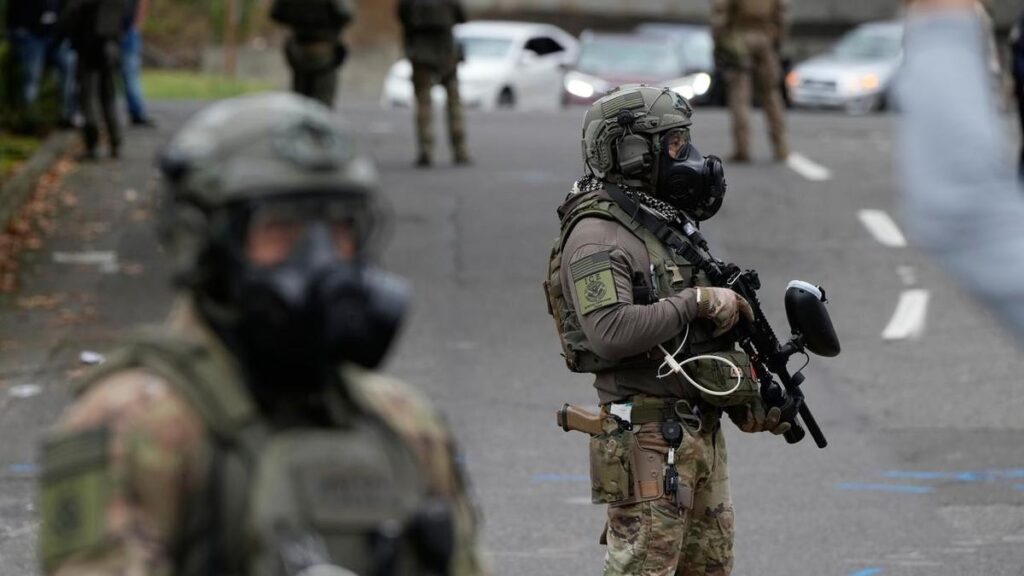
UPDATE: A federal judge has just ruled that President Donald Trump unlawfully ordered National Guard troops to Portland, Oregon, marking a significant legal setback for his administration. US District Judge Karin Immergut issued a permanent block against the military’s deployment to quell protests, asserting that the administration’s claims of rebellion at an immigration detention facility were unfounded.
This ruling comes amid Trump’s ongoing efforts to send troops to other Democrat-led cities, including Los Angeles, Chicago, and Washington D.C.. Immergut’s decision replaces her previous interim order, effectively preventing any military presence in Portland as protests against immigration authorities continue.
The judge, appointed by Trump himself, firmly rejected the administration’s assertion that protestors posed a violent threat warranting military intervention. “This case is about whether we are a nation of constitutional law or martial law,” stated Portland’s attorney Caroline Turco during the trial.
The Trump administration is expected to appeal this ruling, which could escalate to the Ninth US Circuit Court of Appeals and potentially the US Supreme Court. The legal battle began when the City of Portland and the Oregon Attorney General’s Office filed suit in September, challenging the administration’s justification for deploying troops under a law meant for extreme cases of rebellion.
In the courtroom, attorneys for the Justice Department painted a picture of chaos, with attorney Eric Hamilton claiming that “for months, agitators have used violence and threatened violence against the men and women who serve our country.” However, defense lawyers argued that the violence was isolated, effectively managed by local police.
A Reuters review reveals that since June, at least 32 individuals have been charged with federal crimes related to the Portland protests. Among these, 11 have pleaded guilty to misdemeanors, receiving probation. Notably, one protester who threw a knife at an officer could face up to 20 years in prison.
While the administration characterizes the protests as a “war-ravaged” situation, evidence from court documents indicates that the majority of protests have been peaceful. Instances of violence included isolated incidents of protestors kicking and shoving officers, resulting in minor injuries.
This urgent legal decision raises questions about the limits of military power on domestic soil, a topic that has garnered national attention. As the situation develops, observers are keenly watching to see how the Trump administration responds to this ruling and the implications it may have for future deployments.
For those following this unfolding story, the next steps will be critical, as the legal ramifications could reshape how federal forces are deployed in domestic unrest moving forward. Stay tuned for more updates on this significant legal battle.