




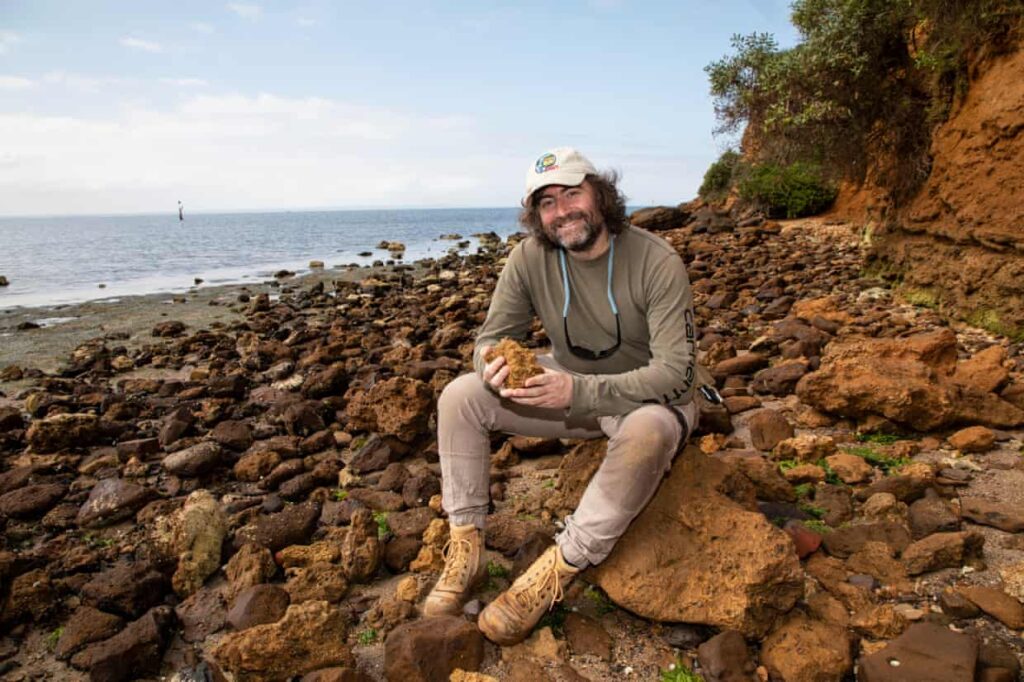
UPDATE: Beachgoers at Jan Juc on Victoria’s Surf Coast are uncovering ancient fossils, with researchers confirming significant finds from 25 million years ago. As powerful Southern Ocean swells erode the cliffs, visitors are discovering remnants that could reshape our understanding of life’s evolution on Earth.
Dr. Erich Fitzgerald, senior curator at Museums Victoria Research Institute, states, “You can be there discovering a fossil that might change our understanding of the evolution of life on Earth.” These discoveries include pieces of whale bones and shark teeth, remnants from the critical Oligocene period that could illuminate the evolutionary story of whales.
Excitement is palpable as individuals from all walks of life—novices, enthusiasts, and experts alike—dive into this fossil treasure hunt, just a short trip from Melbourne. “You can find fossils of nearly all geological periods in Victoria,” says palaeontologist Prof. John Long, emphasizing the geological diversity that allows such finds.
Fossils discovered at Jan Juc include previously unknown species like the tiny-toothed baleen whale, Janjucetus dullardi, and “substantial” penguins over a meter tall, all preyed upon by the ancient shark Carcharocles angustidens, a precursor to the infamous megalodon.
The state’s rich fossil history is underscored by discoveries like Australia’s first dinosaur specimen, unearthed in Inverloch in 1903. Recent finds include fossilized claw prints dating back 354 million years, providing evidence of early land-dwelling creatures.
“Fossils are everywhere,” says Sally Hurst, palaeontologist and founder of Found a Fossil. “Most discoveries aren’t made by scientists but by the public.” She encourages fossil hunters to visit museums for guidance and emphasizes safety rules—no digging without a permit and always document findings with GPS coordinates.
Ben Francischelli, another key figure in the fossil community, often explores Beaumaris Beach, just 20 minutes from Melbourne. This site boasts marine fossils dating back 5 to 6 million years, ideal for first-time fossil hunters. He advises searching during low tide for the best chance of spotting treasures like heart urchins or shark teeth.
For those interested in dinosaurs, the Dinosaur Dreaming project along the Bass Coast offers a rich site for Cretaceous finds, including diverse dinosaur species and early mammals. Lesley Kool, the project coordinator, emphasizes the significance of public involvement in locating important fossils.
As fossil hunting gains popularity, local institutions are encouraging citizens to report significant finds. Fitzgerald notes, “We really do rely on the public doing the right thing and letting us know when something really significant has been found.”
The thrill of discovery is drawing more people to engage with Australia’s deep prehistoric past. Fitzgerald insists that fossil hunting is not just about the finds; it’s a chance to connect with nature and history. “It’s 95% walking and looking,” he explains, offering an enriching experience of enlightenment and discovery.
Stay tuned as more individuals flock to Victoria’s beaches, uncovering remnants of ancient life and contributing to ongoing scientific research. With every tide, new treasures await those willing to explore.
