




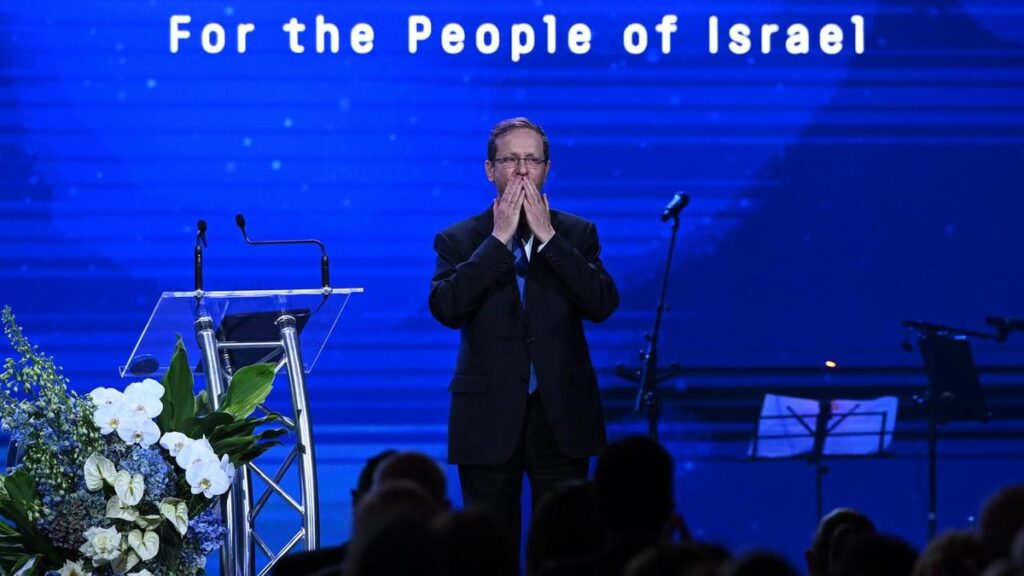
UPDATE: Israeli President Isaac Herzog concluded his controversial visit to Australia amidst widespread protests and significant public division. The four-day trip, which aimed to strengthen ties following the Bondi terror attack, has instead ignited tensions across multiple states.
As Herzog departed from Melbourne on Thursday night, the sentiment surrounding his visit remained polarized. Protests erupted throughout his journey, with demonstrators calling for an investigation into Herzog for alleged war crimes. In Sydney, police clashed with protesters, leading to at least 27 arrests and 9 charges during an anti-Herzog rally. Over 10,000 people rallied in Melbourne, voicing their objections to the Israeli president’s presence.
Human rights expert Ben Saul, a professor and UN rapporteur, criticized Herzog’s motives, asserting that the visit was politically charged rather than a mourning mission for the victims of the Bondi attack. “It hasn’t been about the victims of Bondi; it’s been a deliberate political visit,” Saul stated.
During his time in Sydney, Herzog met with victims of the Bondi attack and engaged with students from Jewish schools. He was accompanied by Prime Minister Anthony Albanese at a ceremony at the Chabad of Bondi. Despite the diplomatic engagements, protests were a constant backdrop, as groups demanded accountability for Israel’s actions in relation to ongoing violence in the region.
The legal status of Herzog as a visiting head of state granted him immunity from arrest, unlike Israeli Prime Minister Benjamin Netanyahu, who faces an International Criminal Court arrest warrant. The UN Special Commission of Inquiry recently indicated that comments made by Herzog following the October 7 Hamas terror attack could be interpreted as incitement for genocide, a claim Israel has strongly denied.
In a statement following his meeting with Herzog, Albanese reiterated Australia’s commitment to peace, stating, “We want Israelis and Palestinians to live side by side in peace and security.” He also brought up the death of Australian aid worker Zomi Frankcom, killed by an Israeli drone strike in April 2024, pressing for transparency in Israel’s investigations.
Members of the Jewish community in Australia expressed mixed feelings. Alex Ryvchin from the Australian Jewry Executive Council described the visit as a “tremendous moment” that could help mend historical ties but acknowledged the recent deterioration in relations. “When the president gets to sit across from our leaders, it humanizes each other,” he emphasized.
Despite the protests, Herzog asserted that he aimed to convey a message of goodwill during his visit, stating, “We came here to be with you, to look you in the eye, to embrace and remember.” As he departed, Herzog expressed feeling “empowered” by the interactions during his trip.
The overall impact of Herzog’s visit continues to unfold, with both leaders aiming to address the ongoing challenges in the region. Observers are left questioning how future relations between Australia and Israel will be shaped in the wake of these significant events.
