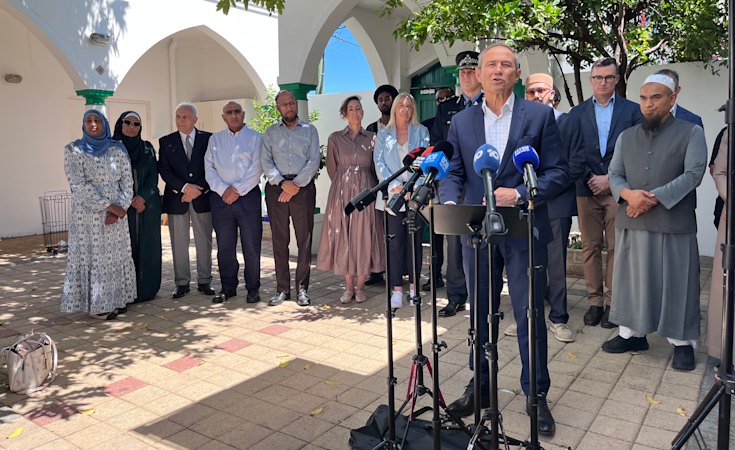
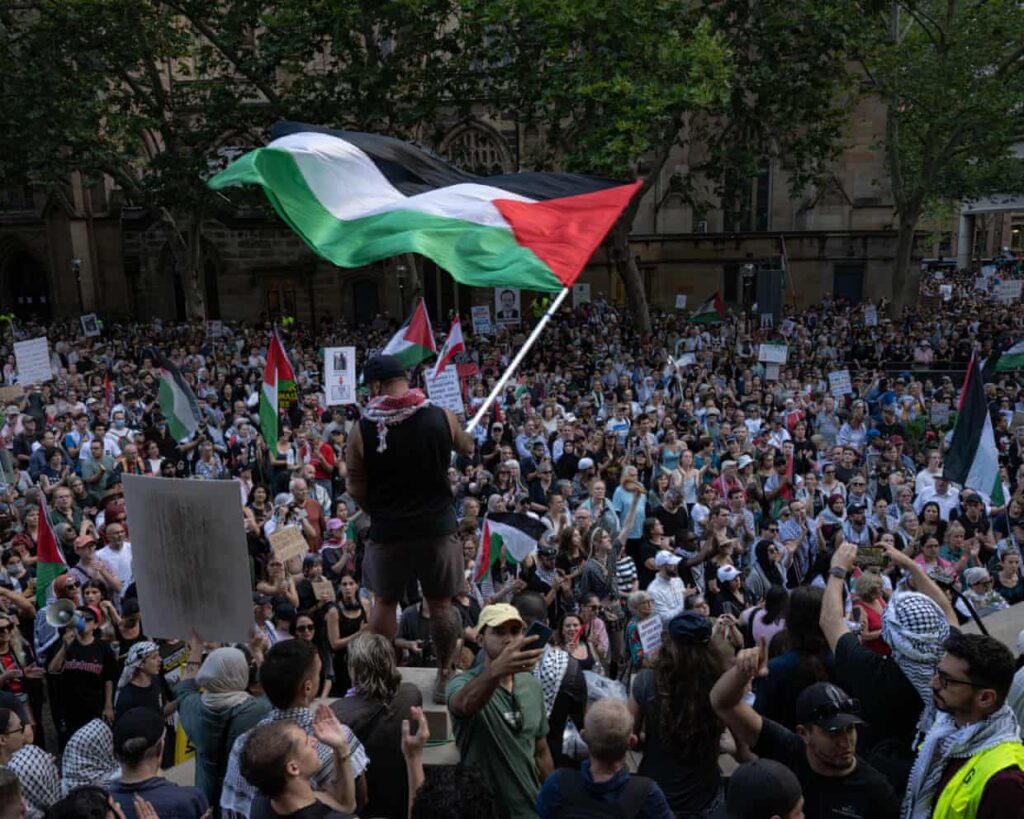
UPDATE: A pivotal court hearing is underway as three protest groups challenge a controversial law imposed by the Minns government that effectively bans marches in Sydney’s CBD. Legal representatives presented their case today, arguing that the new restrictions are exacerbating social tensions rather than enhancing cohesion, which was the government’s stated objective.
The NSW Court of Appeal is examining the implications of this anti-protest law, enacted in response to the Bondi terror incident. The law significantly limits the use of the Form 1 system, which previously offered protest organizers some legal protections. This challenge, filed by the Blak Caucus, Palestine Action Group (PAG), and Jews Against the Occupation ’48, claims these restrictions infringe on the constitutional right to communicate on government and political matters.
David Hume SC, representing the groups, argued before the court that the law might ultimately worsen the very issues it aims to mitigate. He questioned whether the government’s rationale for limiting protests can be considered legitimate under the constitution. “These laws undermine the objectives of protecting the community and enhancing social cohesion,” Hume stated.
The court heard that NSW Police Commissioner Mal Lanyon has repeatedly extended the public assembly restrictions, citing ongoing community safety concerns. Notably, these restrictions were in effect during a recent protest against Israeli President Isaac Herzog in February, which escalated into violence, prompting police oversight investigations.
Hume emphasized that the law’s impact grants police excessive authority to disperse protests, equating it to the “fox guarding the henhouse.” He criticized the law for being overly broad, asserting that it burdens all protests indiscriminately and lacks necessary justification. “The kinds of harms the state was concerned about are already addressed by the criminal law,” he explained.
On the other side, Brendan Lim SC, representing the state, contended that the law is a “confined rollback” of existing legal protections aimed at addressing public safety in the wake of a terrorist attack. Lim maintained that the intent is not to discourage protests but to protect the community. However, Justice Stephen Free challenged this narrative, referencing past statements from Attorney General Michael Daley that suggested the law was designed to signal disapproval of public assemblies in specific areas.
The emotional weight of the situation is palpable, as various Labor backbenchers have expressed concerns that the law could ignite further conflict rather than alleviate tensions. Notably, several members openly participated in protests against the recent restrictions, signaling divisions within the party on the issue.
As the court deliberates, the implications of this case extend beyond legal boundaries, touching on fundamental issues of civil rights and community safety. Observers are keenly awaiting the court’s decision, which could redefine the landscape for protests in New South Wales.
What’s Next: The court’s ruling on this urgent constitutional challenge is expected to have far-reaching consequences for protest rights in Australia. As tensions rise, all eyes will be on the NSW Court of Appeal as it considers the balance between public safety and the right to protest.