




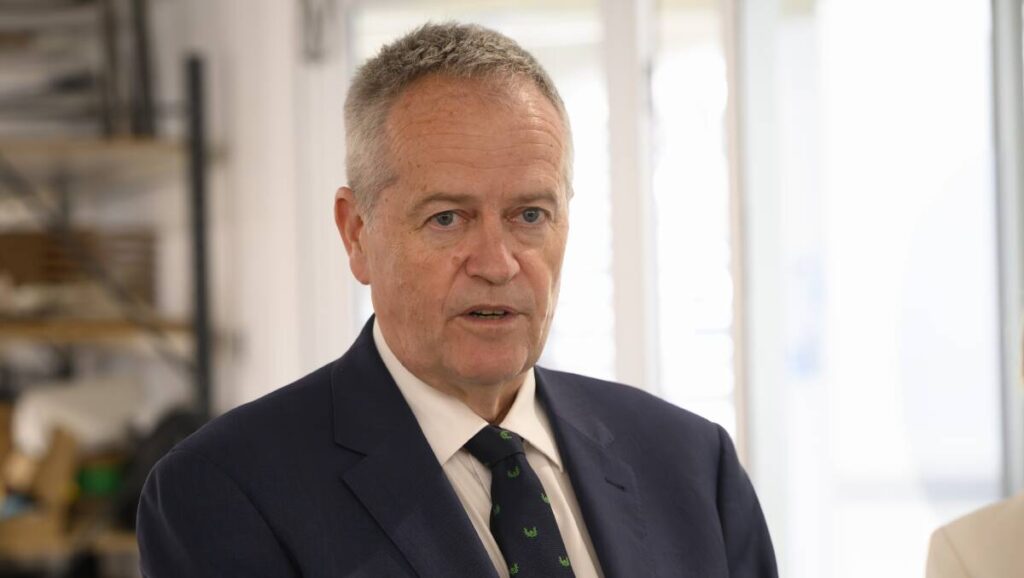
URGENT UPDATE: Former Labor leader Bill Shorten has renewed calls for reform of the capital gains tax in Australia, citing ongoing inequality within the property market nearly four years after his controversial proposal contributed to his party’s election loss in 2019. Shorten believes that the current tax settings disproportionately favor property investors, leaving middle-class wage earners at a disadvantage.
In 2019, Shorten suggested cutting the capital gains tax discount from 50 percent to 25 percent, a policy that was met with widespread disapproval among voters. The proposal was intended to address inequality but failed to resonate, leading to the re-election of Scott Morrison as Prime Minister. Despite this setback, Shorten remains firm that the principle behind his proposal is still relevant today.
“Income is taxed too heavily, but property profits are taxed too little,” Shorten stated, emphasizing the unfair burden on the 13.5 million Australians who earn income through traditional employment, including plumbers, nurses, and academics. He criticized the disparity in tax treatment, where individuals can profit from property sales with minimal tax obligations while hardworking Australians face steep tax rates.
Shorten, who left politics in early 2025 and now serves as vice-chancellor of the University of Canberra, highlighted that the capital gains tax is part of the income tax system applied to assets that appreciate in value over time, often due to inflation. The introduction of the flat discount by former Prime Minister John Howard eliminated the need to adjust gains for inflation, benefiting investors significantly.
He pointed out that while homeowners are exempt from capital gains tax, those profiting from rental properties often benefit from negative gearing, which allows them to deduct losses and further amplify their profits.
“The current settings create disadvantages for average earners,” he remarked. “You can do nothing all day, not be a teacher or a nurse, and simply sit on a building, sell it, and pay minimal tax on those profits. This is grossly unfair.”
While Shorten did not propose specific policy changes, he emphasized that the government must address these disparities to create a more equitable tax system. His previous 2019 proposal was not framed as a solution to the housing crisis, but rather as a means to target inequality and enhance government revenue.
“That was my principle in 2019. I still think that principle holds true, but I’m now out of politics,” he concluded. Shorten stated that it is now up to the Prime Minister and the Treasurer to determine their course of action regarding potential reforms.
As the debate over tax reform continues, the implications of Shorten’s comments could reignite discussions around capital gains tax adjustments in Australia. Observers will be watching closely to see if the current government addresses these pressing issues in their upcoming policy decisions.
