




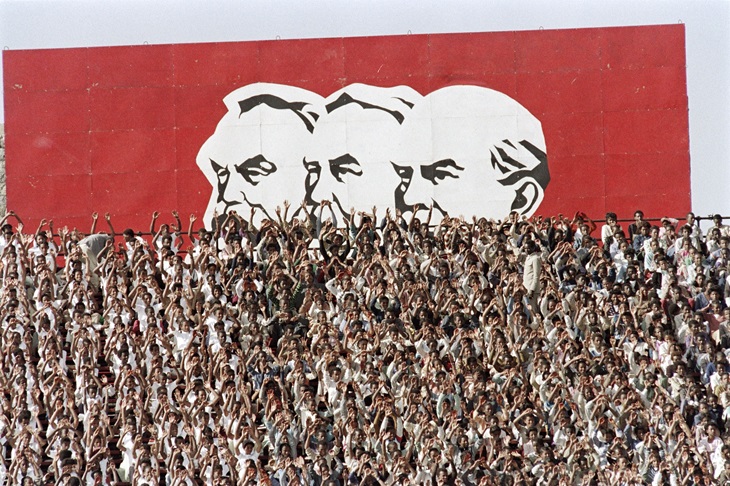
Supporters of pro-communist Ethiopian Workers' party wave in front of a huge portraits of the founders of the "scientific socialism" (from left) Karl Marx, Friedrich Engels and Russian Bolshevik revolutionary leader Vladimir Ilyich Lenin as they celebrate 13 September 1987 in Addis Ababa the 13rd anniversary of the Ethiopian revolution led by Haile Mariam Mengistu. Mengistu, born in 1937, took part in 1960 in the attempted coup against Haile Selassie and in 1977, and after a further coup, became undisputed Ethiopian ruler. He set out to create a socialist state in Ethiopia aligned with the communist block, but was overthrown in 1991 by the Ethiopian People's Democratic Front. (Photo credit should read ALEXANDER JOE/AFP via Getty Images)
URGENT UPDATE: A powerful critique of socialism is making waves as a former Soviet immigrant reveals shocking truths about its impact on society. In a compelling narrative, he draws from his experiences in both the USSR and Australia, emphasizing the dangerous allure of socialist ideologies and their real-world consequences.
The author, who arrived in Australia in 1978, describes a startling disconnect between the local perception of socialism and its historical reality. Many Australians, he notes, seem blissfully unaware of the extremities of socialism, often romanticizing its principles without understanding the inherent risks.
“Socialism is a philosophy of failure,” wrote Winston Churchill, encapsulating the author’s perspective. He recalls witnessing the Communist Party of Australia’s underwhelming presence during the Moomba parade, where its float was a mere sign mounted on bicycles pushed by the elderly – a stark representation of a fading ideology that few took seriously.
As he engaged with local citizens about Marxism, he found alarming ignorance: none had read The Communist Manifesto, nor did they comprehend the potential ramifications of allowing such ideologies to gain traction. The author highlights the “vague ideas of ‘social justice’” that many wealthy Australians support, often blind to the Labor Party’s platform advocating for “democratic socialism.”
The narrative becomes more sobering as he reflects on the communal land ownership among Indigenous Australians, likening it to a Soviet-style collectivization. He urges readers to consider the implications of socialism’s promises: “We will work less and be paid more.” This principle, he argues, is a recipe for economic disaster.
DEVELOPING INSIGHT: The author warns that socialism relies on creating victim groups and common enemies, which shifts over time to maintain relevance and power. He cites historical examples, from the Jews in Nazi Germany to the educated elite in Cambodia, illustrating how these ideologies morph to suit the narrative of the day.
“The average age of the world’s greatest civilizations has been 200 years,” he notes, stressing the cyclical nature of democracies that eventually collapse under the weight of fiscal irresponsibility. He questions whether today’s leaders understand the long-term consequences of their policies.
As the discourse around socialism gains momentum globally, this personal account serves as a stark reminder of the fragility of freedom and the implications of economic promises that seem too good to be true.
WHAT’S NEXT: As debates around socialism and capitalism intensify in Australia and beyond, this immigrant’s story is a crucial call to action. Citizens are urged to scrutinize the underlying principles of political ideologies and consider their historical contexts.
In a world rapidly shifting towards populism and radical ideas, understanding the lessons from history is more critical than ever. The author’s reflections not only illuminate the past but also serve as a warning for future generations.
Stay tuned as we continue to follow this developing story on the impact of political ideologies on society and economy. Share this urgent message to raise awareness about the realities of socialism and its consequences.