



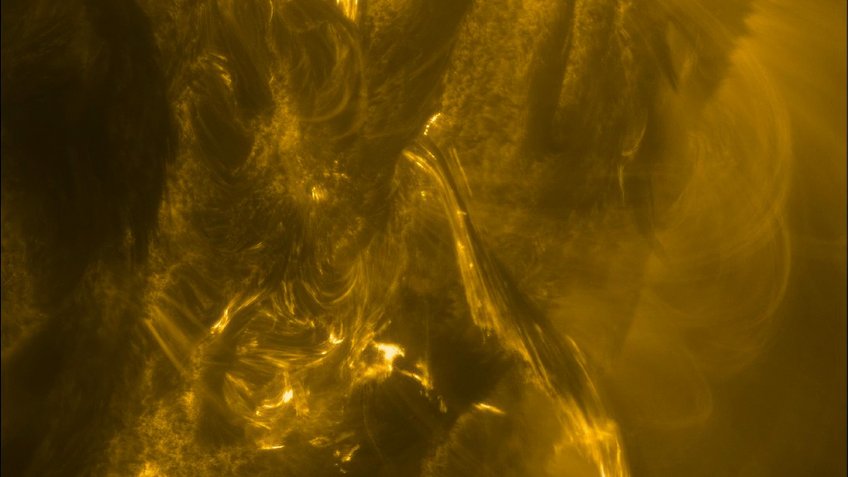
On September 30, 2024, the European Space Agency’s (ESA) Solar Orbiter observed a significant solar flare, capturing the event with unprecedented precision. The space probe was positioned approximately 45 million kilometers from the Sun, at its closest point in its elliptical orbit, allowing for optimal observation of a powerful M7.7-class solar flare. This event, while not the most potent, was one of the more visually striking solar eruptions, releasing a surge of radiation and particles into space.
The observation was particularly fortuitous. According to Lakshmi Pradeep Chitta from the Max Planck Institute for Solar System Research, “It was extremely fortunate that Solar Orbiter, the most powerful solar observatory in space, was looking at the flare at exactly the right time and from exactly the right angle.” Months prior, Chitta and his colleagues had planned an observation campaign for this date, although they did not anticipate such a dramatic eruption.
Solar flares can disrupt radio communications on Earth and pose risks to satellites and power supplies. Understanding the mechanisms behind these eruptions is crucial for mitigating their impact. Sami K. Solanki, Director of the Max Planck Institute, emphasized the importance of studying solar activity, noting that “more powerful solar flares can have even more far-reaching consequences.” The energy released during such flares is generated by changes in the Sun’s magnetic field, which can store and release energy in dramatic bursts.
Unraveling the Mechanics of Solar Eruptions
The Solar Orbiter’s instruments, particularly the Extreme Ultraviolet Imager (EUI), provided a high-resolution view of the solar corona during the eruption. The EUI captured images with a spatial resolution of about 210 kilometers and a high frame rate of two seconds, enabling researchers to witness rapid changes that were previously undetectable. This level of detail is likened to “solar sports photography,” revealing dynamic movements of plasma that had remained hidden in earlier observations.
Around 40 minutes before the flare, the EUI detected a dark plasma loop extending into the corona, suspended by twisted magnetic field lines. This structure acted like a coiled spring, storing energy that would later be released. At approximately 23:47 UTC, a discharge occurred, resulting in an explosive release of plasma and charged particles, accelerated to between 40 and 50 percent of the speed of light.
The immediate moments preceding the flare provided crucial insights into the processes within the Sun’s magnetic field. Adjacent to the dark plasma loop, researchers observed a delicate network of bright plasma streams. About half an hour prior to the eruption, this structure began to destabilize, initiating a series of smaller reconnection processes. These events triggered an avalanche effect, culminating in the larger solar flare.
“Solar Orbiter gave us a window right into the foot of the flare where this avalanche process began,” said Chitta. The study of these smaller reconnection events revealed that they significantly contributed to the energy released during the flare.
Significance of the Findings
This research, detailed in the journal Astronomy & Astrophysics, highlights that not all energy from the flare is expelled into space; some is transferred to the surrounding plasma, causing it to rain down in high-speed blobs. This phenomenon, observed in unprecedented detail in extreme ultraviolet light, underscores the intricate mechanics of solar flares.
Miho Janvier, co-Project Scientist for Solar Orbiter at ESA, remarked on the implications of these findings. “This study is one of the most exciting results from Solar Orbiter so far,” she stated. “An interesting prospect is whether this mechanism happens in all flares and on other flaring stars.”
The Solar Orbiter’s observations not only enhance our understanding of solar dynamics but also pave the way for future studies that could reveal similar processes on other stars. As researchers continue to analyze the data, the potential for new discoveries about solar flares and their impacts on space weather remains vast.