




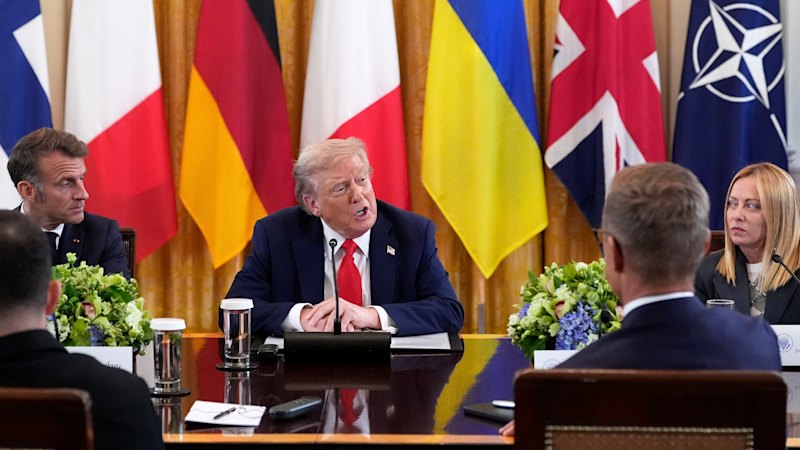
UPDATE: In a shocking interview published on October 17, 2023, US President Donald Trump unleashed a fierce critique of Europe, labeling the continent as “decaying” and its leaders as “weak.” This incendiary statement intensifies the ongoing rift between the US and its traditional allies.
Trump’s comments, featured in an interview with the news website Politico, suggest a willingness to support far-right political candidates across Europe. He specifically singled out London’s left-wing mayor, Sadiq Khan, calling him “a horrible, vicious, disgusting mayor” for his governance of the city.
The President’s remarks come as peace talks aimed at resolving the ongoing conflict in Ukraine have reached a stalemate. Trump’s frustration is palpable as he emphasized the need for stronger political resolve from European leaders, stating, “They talk but they don’t produce. And the war just keeps going on and on.”
Trump’s commentary on Europe coincides with a newly released US national security strategy that warns of a deteriorating situation in Europe due to issues like illegal migration and the influence of an overbearing European Union. Significantly, the strategy refrains from directly blaming Russia for its aggressive actions in Ukraine, which have continued for nearly four years.
During the interview, Trump indicated that he believes Ukrainian President Volodymyr Zelensky must “start to have to play ball” in negotiations, hinting at a potential shift away from the peace talks. “Russia has the upper hand,” he stated, underlining the military imbalance in the ongoing conflict.
Trump’s comments are drawing alarm from European leaders. German Chancellor Friedrich Merz criticized parts of the US strategy as “unacceptable,” while European Commission President António Costa cautioned Trump against interference in European politics, asserting, “If we are allies, we must act as allies.”
As the situation develops, Zelensky announced that a refined version of the peace plan, crafted in collaboration with European officials, is set to be presented to the US. He expressed optimism about quickly moving forward with potential steps to resolve the conflict.
The implications of Trump’s remarks extend beyond diplomatic relations; they signal a potential shift in US foreign policy that could align with far-right parties in Europe. Trump’s previous support of figures like UK’s Nigel Farage and admiration for Hungary’s Viktor Orbán suggest a strategy that may further marginalize traditional parties in Europe.
As the world watches the unfolding dynamics, the urgency for a cohesive response from Europe grows. The stakes are high, with both geopolitical stability and humanitarian concerns at play. This developing story will continue to have significant ramifications for US-European relations and the ongoing conflict in Ukraine.
