




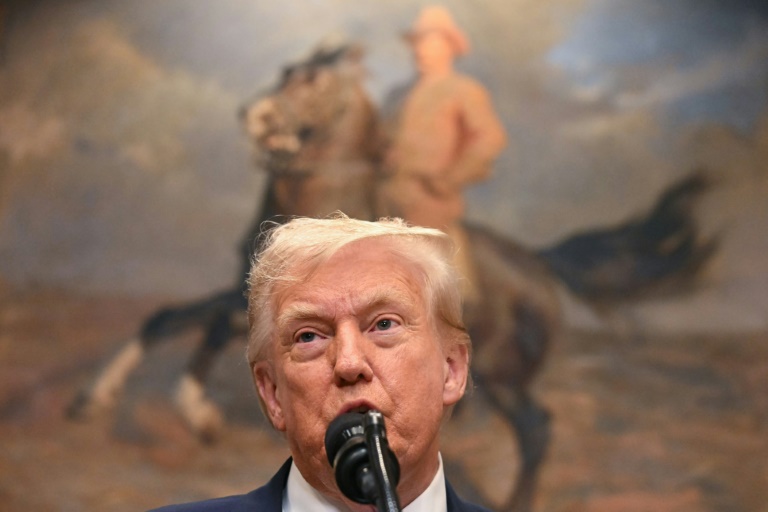
President Donald Trump has intensified his rhetoric regarding the ongoing military campaign against Iran, demanding the country’s “unconditional surrender” amid escalating airstrikes and missile exchanges. This declaration came on October 27, 2023, marking the seventh day of hostilities in a conflict that has already claimed over 1,200 lives in Iran, according to the Iranian Red Crescent Society.
In a statement posted on social media, Trump emphasized that there would be “no deal” to end the war without Iran’s complete capitulation, framing the demand as a necessary step toward eliminating Iran’s nuclear capabilities. “There will be no deal with Iran except UNCONDITIONAL SURRENDER!” he wrote, suggesting that such a move could pave the way for a change in Iran’s leadership.
The statement coincided with reports of renewed U.S. and Israeli airstrikes targeting Iranian military installations and nuclear facilities. In retaliation, Iran has launched attacks on U.S. bases in the Gulf and Israeli cities, further complicating an already volatile situation.
Escalation of Conflict
In response to Trump’s ultimatum, Iranian Supreme Leader Ayatollah Ali Khamenei vehemently rejected the demand, stating during a televised address that Iran “will not surrender to anyone in the face of imposition.” Khamenei’s remarks highlighted Tehran’s defiance and warned of “irreparable damage” to the U.S. if it escalates its involvement.
The conflict began with Israeli airstrikes on Iranian nuclear sites, prompting the U.S. to engage directly in operations dubbed “Operation Epic Fury.” Trump characterized the military campaign as essential to preventing a “nuclear war” that could threaten multiple countries. While he claimed that U.S. forces had significantly damaged Iran’s military capabilities, independent verification of such claims remains limited.
The situation on the ground has drawn significant international concern, particularly regarding potential radioactive contamination. The International Atomic Energy Agency reported damage to facilities at Iran’s Natanz nuclear site, raising alarms about the implications of the strikes. Following Israeli airstrikes in Tehran and surrounding areas, evacuations were ordered in several cities, including Arak and Khandab.
Iranian state media reported significant casualties, including the deaths of key military figures in the ongoing conflict. In response to these attacks, the Islamic Revolutionary Guard Corps has claimed to have targeted 20 U.S. military installations across the Gulf region.
Global and Economic Implications
The ramifications of this conflict have extended beyond immediate military engagements, significantly affecting global oil markets. Following Trump’s demand for Iran’s surrender, Brent crude oil futures surged past $90 per barrel, with disruptions in the Strait of Hormuz, a critical shipping lane. Analysts have noted a volatile reaction in global markets, with stock indices dipping and energy prices rising over 50% since the conflict began.
International responses to the escalating situation have varied. German Chancellor Friedrich Merz met with Trump to discuss the military campaign, predicting its duration could extend for “weeks.” The United Nations Security Council has called for restraint, but efforts to pass resolutions have been stymied by vetoes from permanent members. Countries such as China and Russia have condemned the strikes as acts of aggression, while allies like the United Kingdom have expressed measured support but criticized Trump’s approach.
Domestically, the U.S. Congress narrowly rejected a war powers resolution, revealing partisan divides on the issue. Trump justified the military actions by citing Iran’s advancements in nuclear technology and missile threats, echoing his longstanding criticisms of the nuclear agreement established during the Obama administration.
As the conflict continues without a clear resolution, humanitarian concerns have mounted. Iranian officials have accused the U.S. and Israel of targeting civilians, including schools and hospitals. Protests have erupted in Tehran and other cities as internal unrest grows.
As night falls in the region, Israel has reported intercepting missiles over Tel Aviv, while Iranian officials have vowed to continue their resistance. The White House indicated that Trump is still deliberating on the extent of U.S. involvement, leaving the international community on edge. With no ceasefire currently in sight, the potential for broader conflict looms as the war’s origins trace back to escalating tensions surrounding Iran’s nuclear ambitions.
Experts warn that this conflict could lead to significant casualties and regional instability, with Trump insisting on “complete victory” defined by the absence of nuclear weapons in Iran. As the situation develops, the path to resolution remains uncertain, raising concerns about the future of U.S.-Iran relations and regional security.