




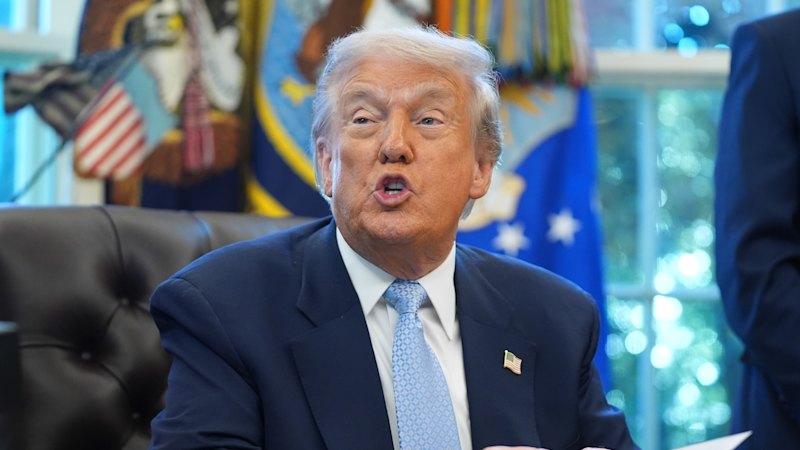
UPDATE: President Donald Trump has just announced a sweeping new economic plan that proposes using tariff revenue to eliminate personal income taxes across the United States. This ambitious proposal, revealed during a video call with military members, raises immediate questions about its feasibility and potential impact on the economy.
In a statement made last Thursday, Trump claimed that the revenue generated from tariffs could lead to “substantially cutting and maybe cutting out completely” the income tax for Americans. He argued that the money flowing in from tariffs would be “so large” that it could support both a $2,000 “tariff dividend” for households and substantial tax cuts.
This announcement follows Trump’s earlier suggestions that tariff revenue would help fund the abolition of income taxes entirely, a concept he has floated since the 2022 election campaign. However, officials and analysts are expressing skepticism about these claims, urging caution regarding their economic implications.
According to data from US Customs and Border Protection, the US has collected approximately $195 billion in tariff revenue this year, with only $118 billion related to Trump’s recent tariffs. Experts warn that using this money to fund major tax cuts could lead to a significant budget shortfall.
To put this into perspective, eliminating income taxes for households earning less than $200,000 could cost around $700 billion annually, while fully removing individual income taxes could escalate to nearly $2.6 trillion per year. These figures starkly contrast with the anticipated tariff revenue, which the Yale Budget Lab estimates to be a net of $2.3 trillion between 2026 and 2035.
“The numbers simply don’t add up,” said a senior economist at the US Tax Foundation. “This plan could exacerbate the already increasing US deficit and debt.”
Currently, the US national debt has surged from $36.2 trillion to $38.1 trillion in less than a year. Trump’s latest plan, which includes a series of tax cuts primarily benefiting the wealthy, is expected to inflate this debt further. Critics argue that the proposed tariff revenue will not cover the costs of his ambitious tax cuts, leaving taxpayers responsible for the deficit.
The president’s supporters, particularly those in the MAGA movement, have responded enthusiastically, taking to social media to express their support. However, economic officials within Trump’s administration have yet to publicly challenge these claims, despite the mounting evidence against them.
As the US Supreme Court prepares to rule on the legality of the tariffs imposed on April 2, 2023, the future of Trump’s economic proposals hangs in the balance. A ruling against the tariffs could further undermine Trump’s plans, which he has touted as a means to alleviate financial burdens on American families.
Looking ahead, the viability of Trump’s tax plan remains uncertain. With tariffs already at an average effective rate of approximately 17%, increasing these rates could discourage imports, further limiting tariff revenue. Experts warn that raising tariffs beyond current levels could lead to a drop in imports and ultimately reduce the revenue intended to support tax cuts.
As this story develops, experts and economists urge caution about relying on tariff revenue as a sustainable source of funding for government operations and tax relief. The implications of Trump’s latest proposals could shape the US economy for years to come, making it crucial for taxpayers to remain informed and engaged.
Stay tuned for updates on this rapidly evolving situation.
