




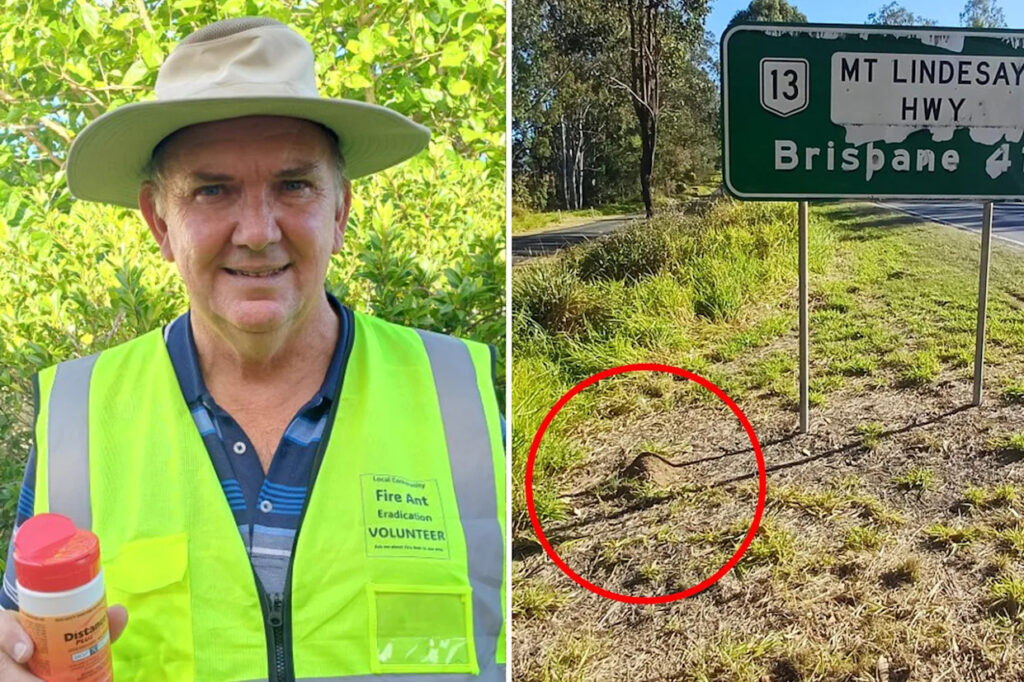
UPDATE: A desperate fight against Australia’s most dangerous invasive species, fire ants, is unfolding as the threat escalates across suburbs. Bruce Reimers, a 65-year-old grandfather from Ormeau, Queensland, is taking action to protect his family and community from this $2 billion biosecurity crisis.
New reports confirm that fire ants are wreaking havoc, threatening crops, livestock, and even human lives. Their painful stings can lead to severe allergic reactions, making this invasive pest a national emergency. Bruce’s personal battle began when he moved to Ormeau just two years ago, unaware of the destructive force that fire ants pose.
He first encountered the invasive species when his son, William Reimers, was diagnosed with bowel cancer. Tragically, William passed away in March 2023, but Bruce is now determined to continue his son’s fight against these pests. “I have taken up that responsibility and am committed to carrying on his efforts,” Bruce said, highlighting his fears for his young granddaughters, aged 3, 8, and 10.
With fire ants spreading rapidly, Bruce has spent at least $50 weekly treating his 5,000 sqm property and surrounding areas. “We let them play outside, but I’m always on high alert,” he shared. His commitment extends to public spaces, as he aims to keep his family and community safe.
Bruce has enlisted the help of the National Fire Ant Eradication Program (NFAEP), which is implementing treatments including aerial bait dispersal and ground operations. However, the fight is intensifying as some homeowners resist allowing biosecurity officials onto their properties, risking fines of up to $16,690.
The danger is real; a young boy in Texas tragically died after standing on a fire ant mound during a soccer game. Bruce’s own close call came recently when he was bitten while cleaning his daughter-in-law’s pool filter. “The girls could still get bitten without seeing a nest,” he warned, underscoring the urgent need for community action.
Fire ants threaten not just individual homes but entire ecosystems, preying on native wildlife and damaging agricultural resources. As their colonies grow, eradication becomes increasingly challenging. The NFAEP is currently on high alert due to increased detections of these pests across various regions.
Bruce has taken proactive measures by creating a high-visibility vest to inform neighbors of his efforts. “Imagine if your next-door neighbor was breeding venomous snakes,” he said, illustrating the potential dangers of ignoring the fire ant threat.
As the situation develops, Bruce calls on the community to unite in this fight. “It’s deeply important to me to continue the fight against fire ants on behalf of my late son,” he emphasized.
Residents impacted by fire ants are encouraged to contact the NFAEP and participate in eradication efforts. This urgent situation is not just a local issue; it demands national attention to protect families and future generations.
For more information on the National Fire Ant Eradication Program, click here. Help support bowel cancer research in honor of William Reimers by donating here.
Are you affected by the fire ant invasion? Share your story with us at [email protected]. Stay updated by following us on social media platforms.
