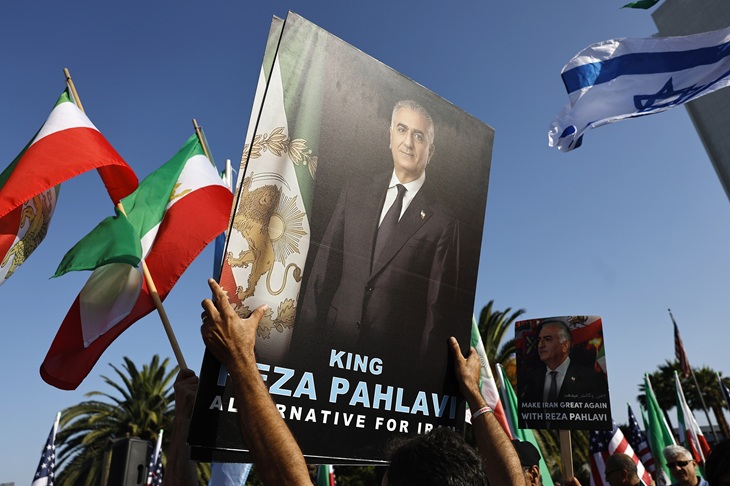
LOS ANGELES, CALIFORNIA - JUNE 23: Supporters of regime change in Iran rally and hold posters of exiled Iranian opposition leader Reza Pahlavi outside the Wilshire Federal Building, on June 23, 2025 in Los Angeles, California. The Los Angeles region holds the largest Iranian community in the world outside of Iran. The U.S. dropped a series of bombs on several alleged nuclear facilities in Iran. President Donald Trump today announced a ceasefire in the Iran-Israel war. (Photo by Mario Tama/Getty Images)
URGENT UPDATE: A growing number of Iranians living in Australia are raising alarm bells over what they call the “distortion of the Iranian people’s voice.” This urgent concern highlights not only the plight of their homeland but also the implications for public discourse and social security in Australia.
Recent protests in Iran have been framed in Australian media primarily as “economic dissatisfaction.” However, demonstrators are explicitly calling for the overthrow of the Islamic Republic, with many chanting the name of Reza Shah in both Persian and English to ensure their demands are not diluted. This conscious effort reflects nearly 47 years of struggle against a regime that has systematically repressed its citizens.
Authorities and activists warn that the oversimplification of these protests undermines the political dimensions of the uprising. By reducing the narrative to mere economic grievances, the media risks normalizing a regime notorious for its history of repression, imprisonment, and violence.
“Normalizing violent ideologies makes societies less safe,” warns Leila Naseri, an Iranian-Australian author and activist. “When victims in Iran and Australia pay the price, questions of political responsibility cannot be ignored.”
The Australian government, led by Prime Minister Anthony Albanese, has faced criticism for its cautious approach towards the Islamic Republic. This lack of pressure sends a clear message: systematic human rights violations go unchecked. The recent Bondi terrorist attack serves as a stark reminder of the potential consequences of allowing extremist ideologies to gain ground.
As protests continue in Iran, the demand for a clear, unfiltered representation of the Iranian people’s voice has never been more urgent. Activists argue that Australian foreign policy must align with the principles of human rights and accountability, rather than remain neutral in the face of injustice.
The Australian public is urged to reconsider how these narratives shape their understanding of global events. Silence and censorship not only fail to address the issues at hand but also risk emboldening oppressive regimes. The call for Reza Shah II as a symbol of national unity and a viable alternative is growing louder among protesters.
In a climate of increasing extremism, communities are left to grapple with the implications of these distorted narratives. The question remains: how long will Australia tolerate a policy that compromises human life in favor of flawed diplomatic calculations?
As the situation develops, both Iranian and Australian citizens are encouraged to engage in open dialogues about the realities of the protests and the need for a coherent foreign policy that prioritizes human rights. The time for action is now—life over death, truth over distortion, and the recognition of a people’s call for change.
For further updates, stay tuned as we continue to monitor this evolving situation.