




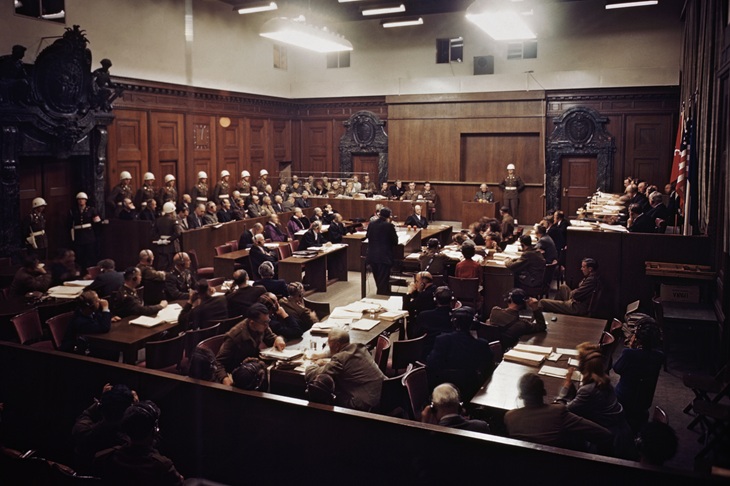
(Original Caption) 1946- Nuremburg, Germany: General View of the trial of Nazi war criminals.
UPDATE: Just moments ago, Melbourne’s Central Business District erupted once again with intense anti-Israel marches, drawing attention to alarming ideological shifts reminiscent of the Nuremberg trials. As crowds gather, chants such as “Sanction Israel!” and “Free Palestine!” echo through the streets, reflecting a growing hostility that raises critical questions about societal values and historical lessons.
The significance of these demonstrations cannot be overstated. With protests intensifying week after week, the uncomfortable reality is that these events are not merely spontaneous outcries but a disturbing reflection of ideological conditioning. This was starkly illustrated on October 9, 2023, when just two days after the brutal killing of 1,200 Israelis and the abduction of around 250 hostages, crowds at the Sydney Opera House shouted antisemitic slogans under illuminated blue-and-white sails.
Authorities attempted to downplay the fervor, claiming the crowd was merely questioning, but the reality was far more sinister. Chants like “Gas the Jews!” and “F**k the Jews!” revealed a deeply unsettling undercurrent of hate that continues to escalate. This pattern of behavior highlights how easily ideology can reshape moral landscapes, a lesson powerfully portrayed in the new film Nuremberg.
This film reconstructs the harrowing post-war trials of Nazi leaders, illustrating how ordinary individuals can commit extraordinary evil when swayed by ideology. Just as the defendants in Nuremberg believed in their own innocence while upholding horrific beliefs, today’s protesters often resort to slogans over nuanced discussions, revealing a concerning trend in contemporary activism.
The backdrop to these protests is equally alarming. For years, Western institutions have accepted significant funding from foreign entities like Qatar, whose ideological goals often clash with democratic values. This dynamic fosters a culture where certain narratives are amplified while others are stifled, ultimately leading to a dangerous simplification of complex issues.
As extremist movements gain traction, Israel becomes a central symbol in a broader ideological battle. Some former hostages have reported that their captors framed their struggle as a fight against the West, indicating a troubling expansion of conflict beyond the Middle East.
The protests in Melbourne are just one manifestation of this rising ideological fervor. Calls to dismantle Australia as a settler colonial state have been linked to the Palestinian cause, showcasing how deeply entrenched these beliefs have become. The historical truth regarding Jewish heritage in Israel is overshadowed by an ideological narrative that demands conformity over factual discourse.
The chilling lessons from Nuremberg remind us of the malleability of human beliefs. Once a moral compass is replaced by ideological certainty, behaviors become predictable, and doubt is seen as betrayal. As slogans drown out meaningful conversation, the risk of violence and division looms larger.
As Australia confronts these profound ideological shifts, the government faces a critical choice: prioritize political convenience or uphold principles that protect humanity. If action is not taken to address the rising tide of extremism, the consequences could be dire, moving from abstract concerns to painful realities.
Amidst this urgent situation, the call to understand history becomes paramount. The power of ideology lies not in obscuring facts but in erasing the very essence of our humanity. As the protests unfold, the lessons learned from Nuremberg serve as a stark warning: those who ignore the past may find themselves repeating its darkest chapters.
Stay tuned for further updates as this developing story unfolds.
