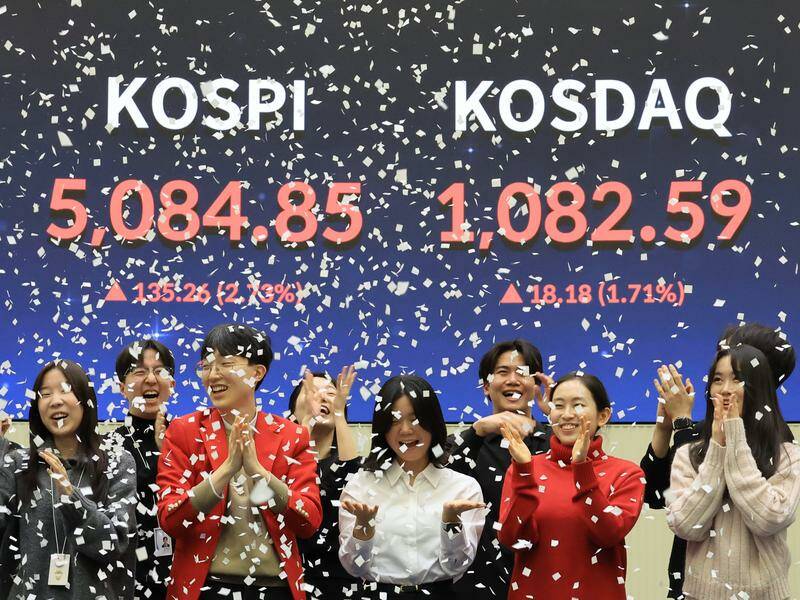
Asian stock markets closed mostly higher following positive momentum from US stock indices, which gained due to strong earnings reports from several companies. The rise reflects a growing investor confidence, despite ongoing geopolitical tensions and trade issues.
Regional Market Performance
In Tokyo, the Nikkei index increased by 0.9 percent, reaching 53,333.54. South Korea’s Kospi surged 2.7 percent, even as US President Donald Trump announced plans to raise tariffs on South Korean imports. This move comes after the South Korean national assembly delayed approval of a previously established trade framework. In response, South Korea’s presidential office affirmed its commitment to the deal, with Industry Minister Kim Jung-Kwan scheduled to meet with US Secretary of Commerce Howard Lutnick in the coming days.
Despite the tariff announcement, South Korean tech shares performed well. Samsung Electronics rose 4.9 percent, while chipmaker SK Hynix saw an impressive gain of 8.7 percent. However, this growth was not universal; automakers faced losses, with Kia down 1.1 percent and Hyundai Motor Co. declining 0.8 percent.
Chinese markets displayed mixed results. The Hang Seng index in Hong Kong advanced 1.3 percent to 27,106.83, while the Shanghai Composite index rose 0.2 percent to 4,139.90. Conversely, the Shenzhen benchmark fell by 0.1 percent. Taiwan’s Taiex increased by 0.8 percent, and India’s Sensex edged up by 0.1 percent.
US Market Influence and Upcoming Reports
In the United States, futures for the S&P 500 gained 0.3 percent, while those for the Dow Jones Industrial Average dipped 0.1 percent. On Monday, the S&P 500 rose 0.5 percent to close at 6,950.23, and the Dow Jones added 0.6 percent to reach 49,412.40. The Nasdaq composite gained 0.4 percent, closing at 23,601.36.
Investors are bracing for potential volatility as the week unfolds with critical economic announcements. The Federal Reserve is expected to announce its interest rate policy on Wednesday, likely maintaining current rates. The Fed has been gradually lowering interest rates to support the job market and stimulate economic growth, although inflation remains above its 2 percent target.
Several major companies are scheduled to release earnings reports this week, including Meta Platforms, Microsoft, and Tesla on Wednesday, followed by Apple on Thursday. These earnings will provide further insights into the health of the US economy.
Baker Hughes led the US market gains, rising 4.4 percent after reporting stronger-than-expected profits, driven by high demand for liquefied natural gas. Additionally, CoreWeave’s stock climbed 5.7 percent following an investment of $2 billion from Nvidia, aimed at expanding its artificial intelligence capabilities. Despite this, Nvidia’s shares fell by 0.6 percent.
In another notable development, USA Rare Earth surged 7.9 percent after receiving $277 million in federal funding to boost the production of rare earth minerals. The company also secured a proposed $1.3 billion loan, complemented by $1.5 billion raised from private investors.
As markets continue to navigate these developments, attention will remain focused on economic indicators and corporate earnings that could influence investor sentiment going forward.
In commodity markets, gold prices resumed their upward trajectory, adding 0.2 percent to reach $5,089.70 per ounce. Silver, however, fell by 2.6 percent. The dollar appreciated against the Japanese yen, rising to 154.56 from 154.20, while the euro slipped to $1.1873 from $1.1881. Crude oil prices also experienced a decline, with US benchmark crude falling 25 cents to $60.38 per barrel, and Brent crude down 30 cents to $64.47 per barrel.
As the international financial landscape evolves, market participants will be closely monitoring these trends and their implications for global economies.