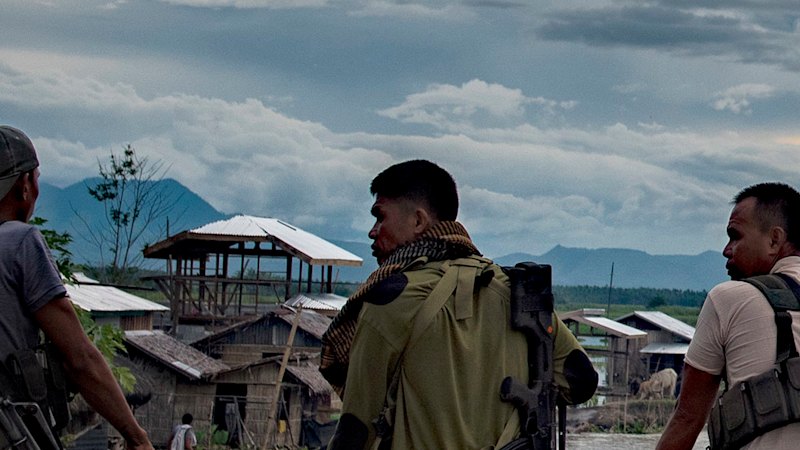
Australian authorities are investigating the activities of Sajid Akram, 50, and his son, Naveed Akram, 24, who recently traveled to the Philippines, specifically to the southern region of Mindanao. This area has long been associated with radical Islamic groups and is known for its connections to terrorist training camps. The investigation centers on whether the Akrams received training from these groups prior to their involvement in a violent attack that claimed 15 lives during Hanukkah.
Philippine immigration officials confirmed that the Akrams arrived in the country on November 1 and departed on November 28 after spending time in Davao, a city known for its proximity to Islamic State activities. Their return flight to Sydney included a stop in Manila. This timeline raises crucial questions about their intentions and possible connections to extremist networks.
Professor Greg Barton, a terrorism expert at Deakin University, noted that Mindanao has been a significant site for insurgency, evolving into a center for jihadi extremism linked first to al-Qaeda and later to the Islamic State since 2014. He highlighted that Davao is the largest city on the island, with relatively easy access to regions where Islamic State affiliates operate.
The movements of the Akrams while in Mindanao remain unclear, but Australian Federal Police Commissioner Krissy Barrett stated that both individuals are believed to have executed a terrorist attack motivated by Islamic State ideology. Following the attack, police discovered homemade Islamic State flags and explosives in their vehicle at Bondi Beach, further complicating the investigation.
As authorities rush to understand the Akrams’ radicalization, they are focusing on Naveed Akram’s earlier connections to extremist circles in western Sydney. Although he had been on the radar of counter-terrorism officials since 2019, his activities were not deemed serious enough for intensive surveillance at that time.
Understanding the broader context of radical activity in the Philippines is essential. In 2017, the city of Marawi witnessed a five-month siege as Islamic State supporters attempted to establish a caliphate in a predominantly Muslim area. The Philippine armed forces, supported by Australian and U.S. forces, eventually reclaimed the city from militants, but the conflict left lasting scars.
Dr. Levi West, a terrorism expert at The Australian National University, emphasized the need for significant connections to insurgent groups to access training facilities in the region. He noted that individuals cannot simply arrive at these camps without prior relationships. This observation raises questions about how two individuals from Australia managed to establish such connections without raising alarms.
While it remains unclear if the Akrams underwent formal training, Barton suggested that psychological reinforcement of their extremist views might have been equally influential. He pointed out that firearms training could occur in various locations, not necessarily in large camps.
The Australian government designated the Islamic State East Asia as a terrorist group in 2017, acknowledging its presence in the Philippines. Despite suffering significant losses after the Marawi siege, the group continues to pose a threat, with recent violent incidents, including a bombing on a passenger bus in Mindanao in 2023.
The Australian government’s Smart Traveller website maintains a “do not travel” advisory for central and western Mindanao due to the high risks of terrorism and kidnapping. As investigations into the Akrams continue, the focus remains on the potential implications for national security and the ongoing challenges posed by extremist groups in the region.