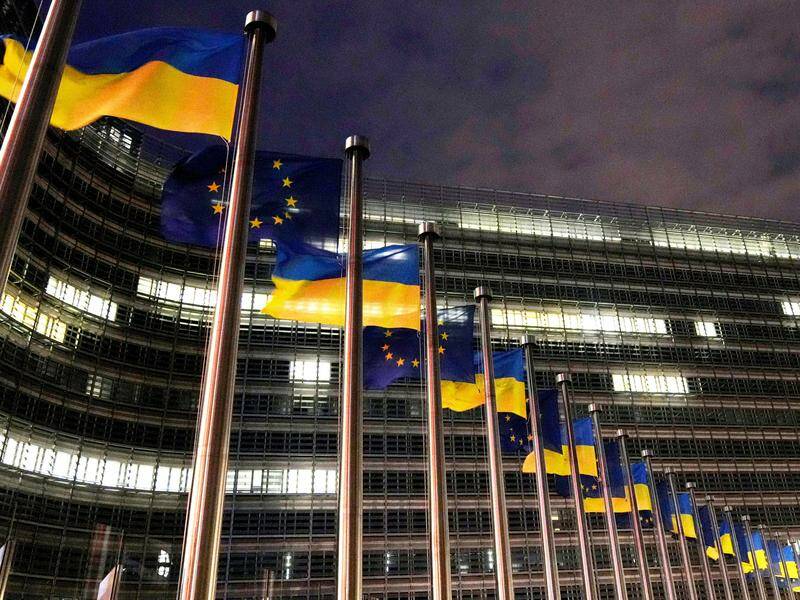
The European Union is poised to lock Russian assets held within its borders until the country ceases its military actions in Ukraine and compensates for the extensive damage caused over the past nearly four years. This decision is a significant step that will enable EU leaders to discuss at an upcoming summit how to utilize the substantial Russian Central Bank assets—amounting to tens of billions of euros—to finance a crucial loan for Ukraine’s financial and military needs over the next two years.
The move comes ahead of a summit scheduled for December 18, where the EU will address the ongoing support for Ukraine. Currently, approximately 210 billion euros (around $370 billion) in Russian assets are frozen in Europe. As of late September, about 193 billion euros of these funds are held in Euroclear, a Belgian financial clearing house. These assets were frozen as part of sanctions imposed by the EU following Russia’s invasion of Ukraine on February 24, 2022.
While the EU sanctions require renewal every six months and the agreement of all 27 member countries, Hungary and Slovakia have expressed opposition to further assistance for Ukraine. Hungarian Prime Minister Viktor Orban, a notable ally of Russian President Vladimir Putin, criticized the European Commission, which prepared the decision. Orban accused the Commission of “systematically raping European law,” suggesting that this action undermines the rule of law within the EU.
In response to the impending decision, Orban stated on social media that “the rule of law in the European Union comes to an end,” arguing that Europe’s leadership is prioritizing political agendas over established legal frameworks. He emphasized that Hungary would “do everything in its power to restore a lawful order.”
Meanwhile, Slovak Prime Minister Robert Fico communicated his disapproval in a letter to European Council President Antonio Costa, who will lead the upcoming summit. Fico indicated that he would not support any initiative that includes funding Ukraine’s military expenses for the coming years. He expressed concern that utilizing frozen Russian assets could undermine peace efforts, particularly those led by the United States, which rely on these resources for Ukraine’s reconstruction.
The European Commission, however, maintains that the ongoing war has inflicted severe economic consequences on the EU, including soaring energy prices and sluggish growth. The bloc has already provided nearly 200 billion euros in support to Ukraine, underscoring the urgency of addressing both humanitarian and military needs.
As discussions unfold, the EU faces the challenge of balancing support for Ukraine while navigating internal dissent from member states opposed to further financial commitments. The outcome of the summit will play a pivotal role in shaping the EU’s strategy in response to the conflict and its implications for the broader region.