European shares experienced a modest uptick as Wall Street futures indicated a potential recovery from last week’s market downturn. Investor caution, however, tempered gains at the start of a week characterized by significant central bank decisions and economic data releases. The benchmark STOXX 600, which includes 600 large companies across Europe, rose by 0.6 percent. Meanwhile, S&P 500 e-mini futures rebounded by 0.4 percent, following a challenging week in which US stocks faced declines due to concerns over a bubble in artificial intelligence shares and persistent inflation pressures.
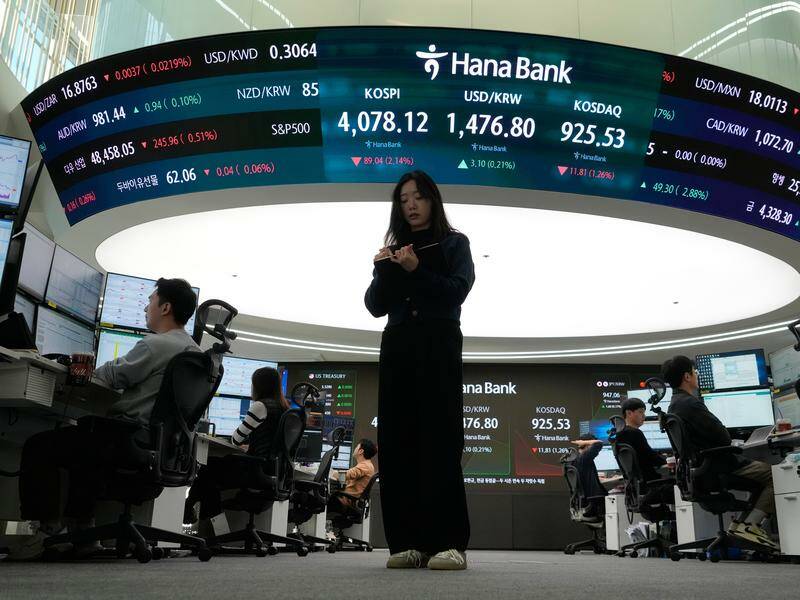
In Asia, market sentiment was less optimistic as worries resurfaced regarding China’s property sector. The MSCI Asia-Pacific index, excluding Japan, fell by 1.2 percent, led by a notable drop of 2.7 percent in South Korean shares, which had previously been one of the strongest markets this year. According to Marc Velan, head of investments at Lucerne Asset Management in Singapore, “The risk-off tone across Asia looks more like a spillover from last Friday’s selloff in US momentum and tech than a region-specific catalyst.”
As investors await crucial economic indicators and decisions from central banks, the yield on the US 10-year Treasury bond decreased by 3 basis points to 4.1645 percent. The US dollar also slipped by 0.1 percent against the Chinese yuan, trading at 7.0486 yuan, remaining near its strongest level in over a year. This shift followed reports of slowing factory output and retail sales in China for November.
Official data released on Monday indicated a continued decline in new home prices in China, reflecting a challenging recovery in demand despite government assurances to stabilize the troubled sector. China Vanke, a state-backed property developer, announced a second bondholder meeting after failing to secure approval for an extension on a bond payment due, raising the risk of default and intensifying concerns regarding the property market. Jeff Zhang, an equity analyst at Morningstar, noted, “If Vanke ultimately defaults, we think the ramifications on the China property sector can be significant.”
This week, several central banks are poised to make critical decisions. The Bank of Japan is expected to increase rates by 25 basis points to 0.75 percent, while the Bank of England may reduce its rate by the same amount to 3.75 percent. The European Central Bank is likely to maintain its current interest rates, as are the Riksbank of Sweden and Norway’s Norges Bank. Investors are also anticipating delayed economic data from the US, which includes the November jobs report and the monthly consumer price index.
Ben Bennett, head of investment strategy Asia at L&G Asset Management in Hong Kong, cautioned that this week’s data should be approached with skepticism due to challenges in data collection stemming from the recent US government shutdown. “We’ll have to wait until 2026 to get a clearer reading on the US economy,” he stated.
In Japan, stocks gained some support after the Bank of Japan’s “tankan” survey revealed a four-year high in business sentiment among major manufacturers, suggesting the economy is adapting to the impacts of increased US tariffs. The Topix index was last up 0.2 percent, while the yen strengthened by 0.6 percent against the US dollar, reaching 154.955.
The New Zealand dollar experienced a 0.4 percent decline to $0.5781 following comments from the newly appointed central bank governor, Anna Breman, who indicated that financial market conditions have tightened recently, leading to reduced expectations for rate hikes in the coming year.
In the commodities market, Brent crude prices increased by 0.5 percent to $61.44, driven by supply concerns linked to tensions between the US and Venezuela. Additionally, Imperial Oil reported a fire alert at its refinery facility in Ontario, Canada, which has a capacity of 120,000 barrels per day. Meanwhile, Russia confirmed that an oil refinery in Afipsky was unharmed following a Ukrainian drone attack.
On the geopolitical front, US envoy Steve Witkoff reported that “a lot of progress was made” in peace negotiations to resolve the ongoing conflict in Ukraine during talks held in Berlin on Sunday.
In the precious metals market, gold prices continued their upward trend, marking a fifth consecutive day of gains as they approached a record high of $4,381.21. Spot bullion prices rose by 1.1 percent to reach $4,348.83.
Cryptocurrency markets ended a three-day losing streak, with bitcoin increasing by 1.5 percent to $89,845, while ether climbed 2 percent to $3,145.