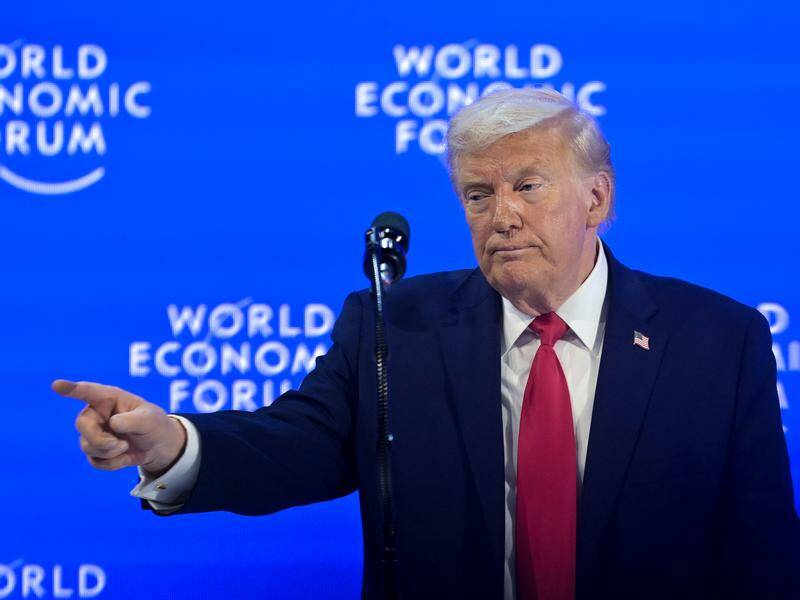
Global shares rebounded sharply on Wednesday after US President Donald Trump announced that a framework for a future deal regarding Greenland has been established. This development followed a significant selloff in the previous session, stirring renewed investor confidence as Trump indicated a halt to scheduled tariffs set to take effect on February 1.
Speaking at the World Economic Forum in Davos, Trump emphasized that the US would not pursue a military approach to acquiring Greenland, which appeared to calm market nerves. Following his remarks, major US stock indexes experienced notable gains. The Dow Jones Industrial Average surged by 1.54 percent, the S&P 500 increased by 1.51 percent, and the Nasdaq Composite rose by 1.66 percent.
Investor Reactions and Market Dynamics
“The market bounced when he said we wouldn’t use force,” said Mark Hackett, chief market strategist at Nationwide in Boston. He noted that investors have started to recognize Trump’s distinct negotiating style, which differs significantly from previous administrations, leading to an environment filled with uncertainty.
The MSCI All-World index increased by 0.87 percent, recovering from earlier losses, while Europe’s STOXX 600 index closed slightly lower by 0.02 percent. In the UK, the FTSE index managed a modest gain of 0.11 percent. The VIX index, which gauges market volatility, fell by more than 15 percent to 16.90, indicating a decrease in investor anxiety. A VIX reading above 20 typically suggests heightened market volatility.
In response to Trump’s aggressive stance on Greenland, the European Parliament decided to suspend work on a trade deal with the US. This move raises concerns about the long-standing US-EU alliance, prompting the European Union to convene an emergency summit in Brussels on Thursday to address the evolving situation.
“You had the Venezuelan issue, Greenland, and Iran, and none of these events seemed to be making a huge impact,” remarked James St Aubin, chief investment officer at Ocean Park Asset Management in Santa Monica, California. He acknowledged the significant selloff the previous day but suggested that the market appears resilient despite the provocative statements from Trump.
Bond Markets and Currency Fluctuations
The global bond market is still recovering from a substantial selloff, primarily driven by concerns over US asset exposure and rising borrowing costs in Japan. Long-dated Japanese sovereign bonds faced their most intense selloff in nearly 25 years on Tuesday, amid fears of increased government spending under Japanese Prime Minister Sanae Takaichi.
US 30-year Treasury yields approached the five percent mark for the first time since September, while German government bond yields also saw sharp increases. However, by Wednesday, Japanese bond prices rebounded as buyers returned, nearly reversing the previous day’s rise in yields. A similar trend occurred in US Treasuries, with 30-year bond yields dropping 2.6 basis points to 4.8951 percent, while the yield on benchmark US 10-year notes eased by 2.4 basis points to 4.271 percent.
In currency markets, the dollar index, which measures the US currency against six others, recovered from earlier losses, rising by 0.28 percent. The euro weakened, falling by 0.36 percent to $1.1684, while the Swiss franc also declined, leaving the dollar up 0.87 percent at 0.7964 francs. The yen slipped 0.19 percent to 158.45 per dollar, ahead of a policy meeting scheduled for Friday, where no rate hike is anticipated.
Oil prices experienced a modest increase, buoyed by optimism surrounding tighter supply following a temporary shutdown at two significant fields in Kazakhstan. However, this was countered by expectations of a rise in US crude inventories. Brent crude futures settled up 0.49 percent at $65.24 per barrel, while spot gold prices surged by 1.89 percent to $4,848.69 per ounce, reflecting ongoing market dynamics.
The interplay of these factors illustrates the complex landscape of global markets, where geopolitical developments and economic policies continue to shape investor sentiment and market trajectories.