
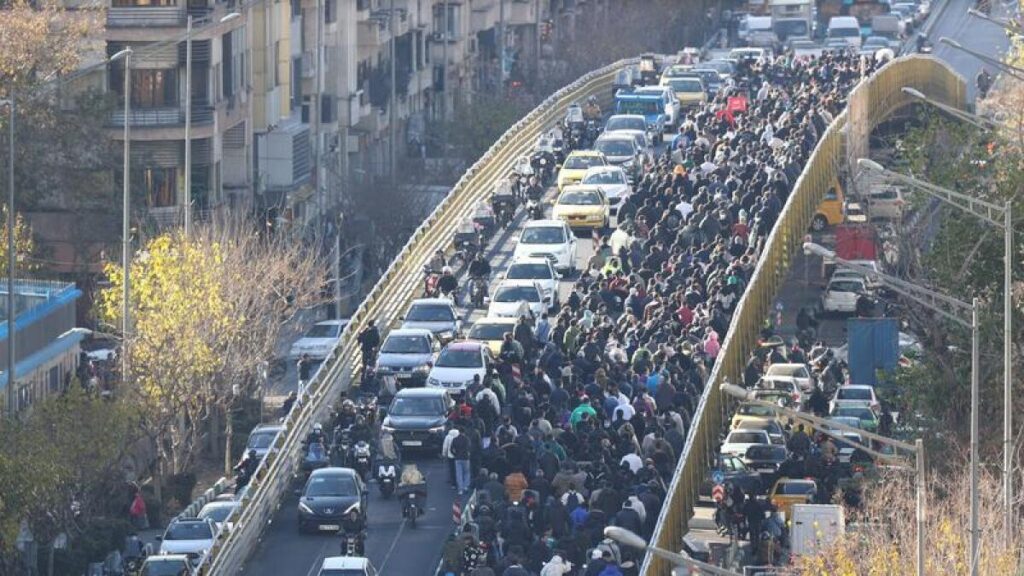
Demonstrations across Iran have escalated into a nationwide movement, driven primarily by economic grievances. According to the US-based Human Rights Activists News Agency, at least 38 people have died, and more than 2,200 individuals have been detained amid the unrest. The protests are exerting significant pressure on Iran’s civilian government and Supreme Leader Ayatollah Ali Khamenei, who faces increasing public discontent.
Despite the rising tensions, Iranian authorities have not yet implemented drastic measures like cutting off internet access or deploying security forces en masse, as they did during the 2022 protests following the death of Mahsa Amini. However, the situation remains fluid, and any intensification of protests could prompt a stronger response from the government.
Protests Spread Across Major Cities
On Wednesday, protests occurred in at least 37 locations, including significant gatherings in Shiraz and Bojnourd. Online videos purportedly show anti-riot trucks utilizing water cannons against demonstrators in Shiraz. The state-run IRNA news agency, which has largely refrained from reporting the extent of the protests, acknowledged a mass demonstration in Bojnourd and smaller protests in Kerman and Kermanshah.
While Iranian officials have not publicly acknowledged the scale of the protests, reports indicate that security personnel have faced violence. The judiciary’s Mizan news agency reported that a police colonel was fatally stabbed in a town near Tehran. Additionally, the semi-official Fars news agency detailed an incident in Lordegan, where gunmen killed two members of the security forces and injured 30 others.
International Reactions and Economic Context
As protests continued into Thursday, merchants in Iran’s Kurdistan province closed their shops in solidarity with demonstrators. Questions remain regarding the Iranian government’s reluctance to escalate its crackdown on protestors.
In an international response, US President Donald Trump issued a warning, stating that if Tehran “violently kills peaceful protesters,” the United States “will come to their rescue.” This statement was met with condemnation from Iran’s foreign ministry, which characterized Trump’s remarks as hypocritical, citing a long history of US interventions in Iranian affairs.
As Iran faces tightening sanctions and economic challenges, the situation has worsened since a brief conflict with Israel in June 2023. The Iranian rial experienced a collapse in December, reaching 1.4 million to $1 USD. Economic hardships have fueled public discontent, with protesters vocally opposing the country’s theocratic governance.
The unfolding protests reflect deep-rooted frustrations with both the economy and the political system, raising significant challenges for the Iranian leadership. As the demonstrations continue to unfold, the global community watches closely, anticipating how Iranian authorities will respond to the growing unrest.