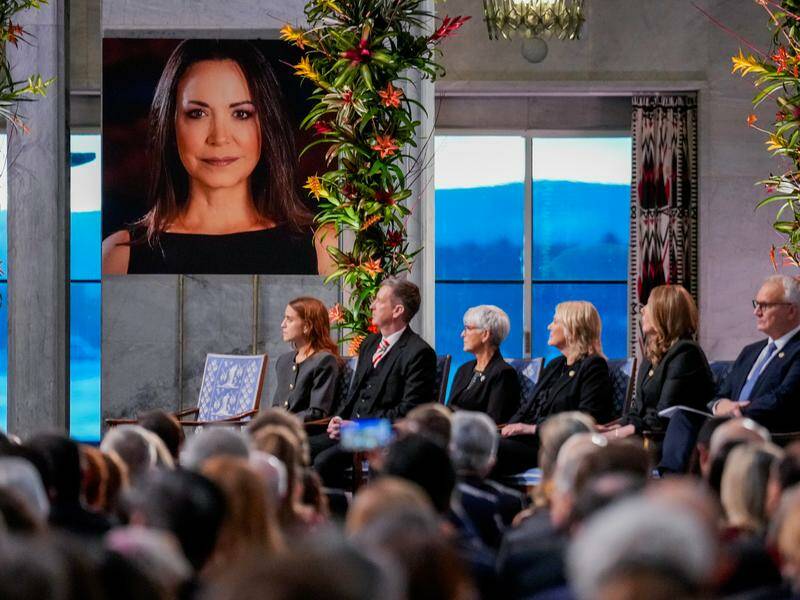
In a significant statement on the global importance of democracy, Nobel Peace Prize laureate Maria Corina Machado emphasized that democracies must be ready to fight for freedom to endure. Delivered by her daughter, Ana Corina Sosa Machado, during an awards ceremony at the Oslo City Hall, Machado’s message underscored the profound meaning of the recognition not only for Venezuela but for the world at large.
“It reminds the world that democracy is essential to peace,” Machado stated through her daughter. “And the most important lesson Venezuelans can share with the world is that if we want democracy, we must be prepared to fight for freedom.” A large portrait of Machado was prominently displayed during the ceremony, symbolizing her absence due to a decade-long travel ban imposed by Venezuelan authorities.
Challenges in Pursuing Democracy
The 58-year-old opposition leader was scheduled to receive the Nobel Prize in person, an event that would have marked a bold defiance against the restrictions she faces. Despite her desire to attend, she was unable to reach Oslo in time. In an audio message released by the Norwegian Nobel Institute, Machado expressed her commitment to being present, stating, “I will be in Oslo, I am on my way to Oslo right now.” The institute’s director, Kristian Berg Harpviken, noted uncertainty regarding her arrival time, indicating she was en route but had not yet landed.
In her prepared speech, Machado poignantly articulated the ongoing struggle for freedom. “Freedom is conquered every day as long as we are ready to fight for her,” she remarked. “This is why the cause of Venezuela transcends our borders. A people that chooses to be free not only liberates itself; it contributes to the whole of humanity.” Her words resonate deeply in a country facing escalating political turmoil.
Following her overwhelming victory in the opposition’s primary elections in 2024, Machado found herself barred from competing in the presidential election. This decision came amid a crackdown on dissent, which intensified in the wake of the disputed elections that saw Nicolás Maduro declared the victor. International observers and the opposition contest this outcome, asserting that Machado’s coalition had won, supported by evidence from ballot box-level tallies.
Reflections on the Path to Dictatorship
In her address, Machado reflected on the gradual erosion of democratic institutions in Venezuela, stating that many citizens did not recognize the threat until it was too late. “When we understood how fragile our institutions had become, it was already too late,” she lamented. She referenced the late president Hugo Chávez, who came to power in 1999, noting that his election was a pivotal moment that many misinterpreted as a benign transition. “When the ringleader of a military coup against democracy was elected president, many thought that charisma could substitute the rule of law,” she said.
Since Chávez’s administration, which ended with his death in 2013, the regime has systematically dismantled democratic structures. Maduro, who has held power since 2013, has accused external forces, particularly the United States, of attempting to undermine his government to seize Venezuela’s vast oil reserves. He claims that both Venezuelan citizens and the armed forces will resist any such intervention.
When Machado was awarded the Nobel Peace Prize in October 2024, she dedicated part of the recognition to former U.S. President Donald Trump. She has aligned herself with hawkish figures who argue that Maduro’s regime is linked to criminal enterprises that threaten U.S. national security, despite conflicting assessments from the U.S. intelligence community.
As the political landscape in Venezuela remains fraught with tension, Machado’s call to action serves as a reminder of the ongoing fight for democracy, not only within her homeland but as a universal struggle against oppression. Her words resonate as a rallying cry for those who believe in the fundamental right to freedom.