

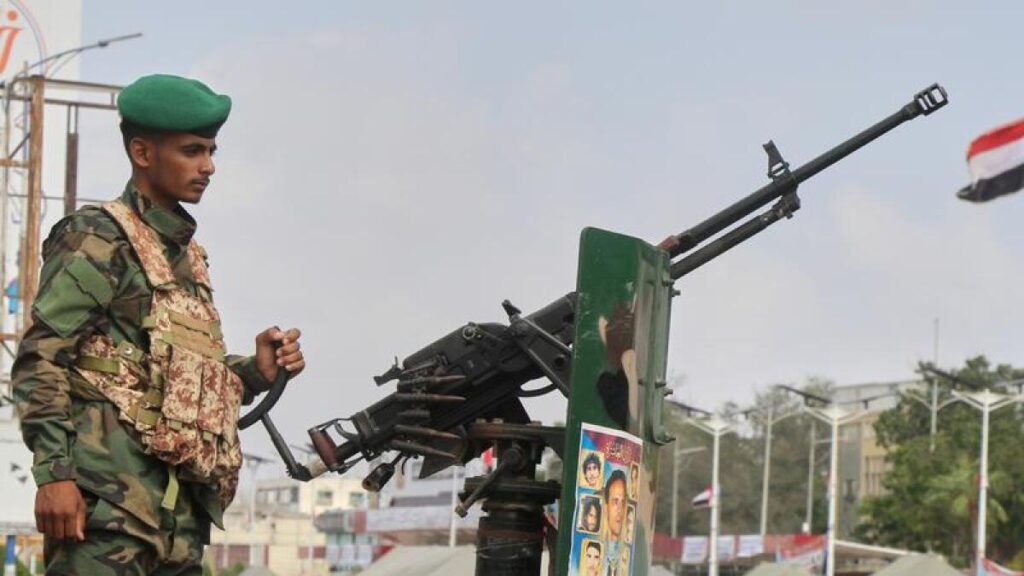
The Saudi-backed Yemeni government has regained control of significant areas in the eastern port city of Hadramout, reversing recent territorial gains made by the Southern Transitional Council (STC). This military shift, which began on Friday, raises questions about the STC’s ambitions for a referendum on independence within the next two years.
The conflict has escalated as STC forces have blocked roads leading to Aden, the temporary capital of Yemen, from northern provinces. Residents reported that the STC has appealed for intervention from regional and international leaders, characterizing the situation as a “Saudi-backed military escalation.” In a statement, the STC accused northern Islamist factions, likely referring to the Islah party aligned with the internationally recognized government, of targeting civilians and critical infrastructure.
The United Arab Emirates (UAE), a key supporter of the STC, expressed concern regarding the rising tensions. The UAE urged all parties to exercise restraint, highlighting the potential for further destabilization in a region already fraught with conflict. Yemen’s strategic position, located between Saudi Arabia and the Bab al-Mandeb strait, underscores its geopolitical significance.
In response to the situation, the head of the internationally recognized government, Rashad al-Alimi, announced that he has requested Saudi Arabia to host a forum aimed at reconciling various southern factions. This initiative aims to unite the disparate groups in the south, which have historically been divided.
Compounding the crisis, Aden airport, the main transport hub for areas outside Houthi control, has remained closed since Thursday due to disputes over new flight restrictions imposed by the internationally recognized government. Both the STC and Saudi Arabia have traded accusations regarding the interruption of air traffic, which has further isolated southern Yemen.
The current upheaval follows a period of territorial expansion for the STC, which seized control of large swathes of land, including Hadramout, earlier this month. This marked a significant shift in the power dynamics within Yemen, where the STC had previously supported the internationally recognized government while seeking greater autonomy.
The situation has led to the most pronounced rift in decades between Saudi Arabia and the UAE. As their interests diverge, the potential for a reconfiguration of alliances in the region has increased. Qatar, another Gulf monarchy with its own regional policy differences, welcomed the internationally recognized government’s efforts to address the southern crisis.
Earlier this week, Saudi Arabia conducted airstrikes on a base in Hadramout, emphasizing its commitment to regional security by demanding the withdrawal of remaining UAE forces from Yemen. The UAE complied with this request, underscoring the pressures facing both nations as they navigate their roles in the ongoing conflict.
The STC’s declaration on Friday, indicating its desire for a two-year transition period leading to a referendum on independence for a new South Arabian state, marks a critical juncture in Yemen’s ongoing strife. This move represents the STC’s most explicit signal of its intent to separate from the north, further complicating an already intricate landscape of alliances and enmities in the region.
As the situation develops, the international community watches closely, aware that stability in Yemen is crucial not only for the region but also for global trade routes that traverse its waters.