


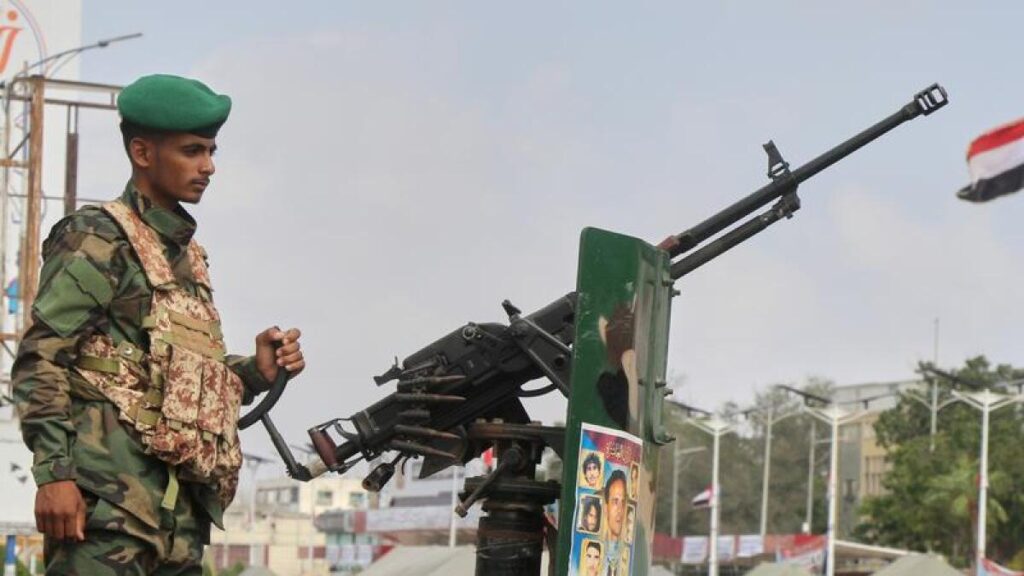
The internationally recognized Yemeni government, supported by Saudi Arabia, has regained control of key areas in the eastern port city of Hadramout. This military advancement has significantly reversed the territorial gains made by the Southern Transitional Council (STC) in the previous month and raises questions about the STC’s plans for a referendum on independence within two years.
Since Friday, government forces have rapidly taken over strategic locations in Hadramout, a province that borders Saudi Arabia. Residents reported that STC forces have blocked key roads leading to the southern city of Aden. In response, the STC issued a statement on Saturday, appealing to regional and international leaders for intervention against what it termed a “Saudi-backed military escalation.” The group accused northern Islamist factions, specifically referencing the Islah party that is part of the recognized government, of targeting civilians and critical infrastructure.
The United Arab Emirates, a primary supporter of the STC, expressed deep concern over the escalating violence in Yemen and urged all parties to exercise restraint. Yemen’s geopolitical significance cannot be understated; it sits at a critical juncture between Saudi Arabia, the world’s largest oil exporter, and the Bab al-Mandeb Strait, a vital waterway for global shipping routes between Europe and Asia.
Historically, the STC has been part of the internationally recognized government, which governs southern and eastern Yemen and is supported by Gulf states in their conflict against the Houthi movement. In a recent statement, Rashad al-Alimi, the head of the Presidential Council, announced he had requested Saudi Arabia to host a forum aimed at uniting southern factions and addressing the ongoing crisis.
Aden airport, which serves as the main transport hub for areas outside Houthi control, has remained closed since Thursday. This closure resulted from a dispute over new flight restrictions imposed by the internationally recognized government on flights with the UAE. Both the STC and Saudi Arabia have accused each other of causing the interruption in air traffic. The STC described the current situation in southern Yemen as a “land, sea, and air blockade.”
The conflict intensified last month when the STC seized control of significant territories, including Hadramout, marking a bold move to establish dominance over the area that once comprised the former state of South Yemen before its merger with the north in 1990. Following this upheaval, the leadership of the internationally recognized government retreated to Saudi Arabia, which viewed the STC’s actions as a threat to its national security.
This crisis has led to a significant rift between Saudi Arabia and the UAE, two allies whose long-standing cooperation has been tested by diverging interests in Yemen. Qatar, another Gulf monarchy with differing regional policies, welcomed the Yemeni government’s efforts to resolve the southern issue, highlighting the complex nature of alliances in the region.
Earlier this week, Saudi Arabia conducted airstrikes on a base in Hadramout and ordered all remaining UAE forces in Yemen to leave, emphasizing that this marked a critical threshold for its security. The UAE complied with this directive. The STC’s declaration on Friday, advocating for a two-year transition period leading to a referendum on independence, represents its clearest signal of intent to pursue secession from Yemen.
As tensions rise and military actions escalate, the stability of Yemen and the broader implications for the region remain uncertain. The international community continues to monitor the situation closely, amid concerns about the humanitarian crisis developing as a result of ongoing conflict.