


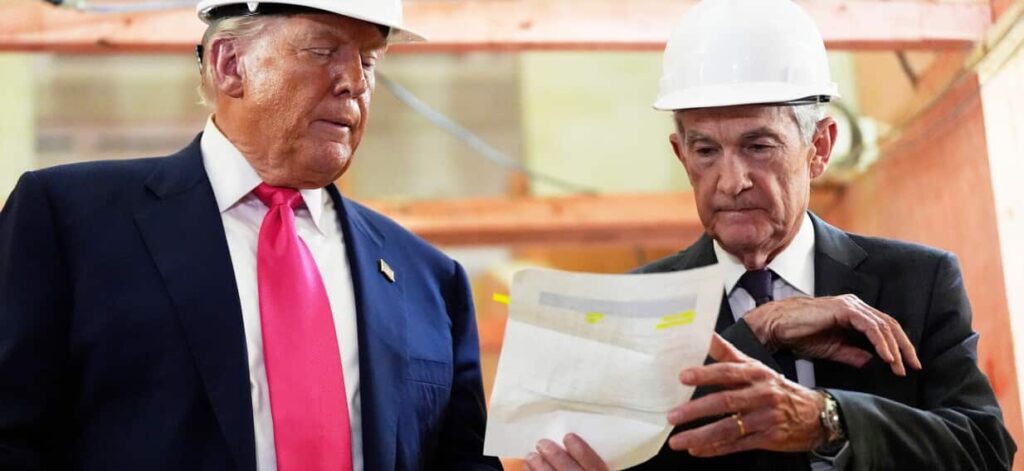
The ongoing conflict between former President Donald Trump and Jerome Powell, the chair of the Federal Reserve, has intensified recently, sparked by comments regarding the central bank’s renovation plans. During a public appearance, Trump criticized Powell’s performance, claiming he has not effectively managed the economy, while Powell alleged that Trump had engaged in intimidating behavior toward him.
In a speech delivered on September 18, 2023, Trump referred to Powell as “not very good,” suggesting that his leadership has contributed to economic uncertainty. This public rebuke marks another chapter in a long-standing disagreement that dates back to Trump’s presidency, when he frequently expressed dissatisfaction with Powell’s policies, particularly regarding interest rate adjustments. Trump’s remarks come amid concerns about inflation and economic recovery, areas where the Federal Reserve’s actions are closely scrutinized.
Powell responded to Trump’s comments, stating that he has felt a level of intimidation from the former president. He emphasized the independence of the Federal Reserve, asserting that it will continue to make decisions based on economic data rather than political pressure. During a recent press briefing, Powell remarked, “We will not be swayed by intimidation tactics. Our focus remains on achieving stable prices and maximum employment.”
The backdrop of this feud includes ongoing renovations at the Federal Reserve’s headquarters in Washington D.C. The renovation project, which aims to modernize facilities and improve workspaces, has become a point of contention. Critics argue that the estimated cost of $50 million for the updates is excessive, especially in light of current economic challenges.
As the tensions between Trump and Powell escalate, the implications for U.S. monetary policy could be significant. Trump’s criticisms may resonate with his political base, which remains skeptical of the Federal Reserve’s approach. Conversely, Powell’s commitment to an independent central bank is crucial for maintaining public confidence in economic governance.
Analysts suggest that this confrontation reflects broader themes in American politics, where economic management often intersects with partisan rhetoric. The Federal Reserve’s decisions play a pivotal role in shaping economic outcomes, making its leadership a frequent target for political figures seeking to influence public perception.
Looking ahead, the relationship between Trump and Powell will likely remain contentious, especially as the Federal Reserve prepares for its next policy meeting. With inflation rates still a pressing concern, the actions taken by the central bank in the coming months will be closely monitored by both economists and politicians alike.
As the political landscape continues to evolve, the dynamics between the White House and the Federal Reserve will be critical in shaping the economic future of the United States. With both figures entrenched in their positions, the potential for further escalation in their feud remains high, underscoring the complex interplay between politics and economic policy.