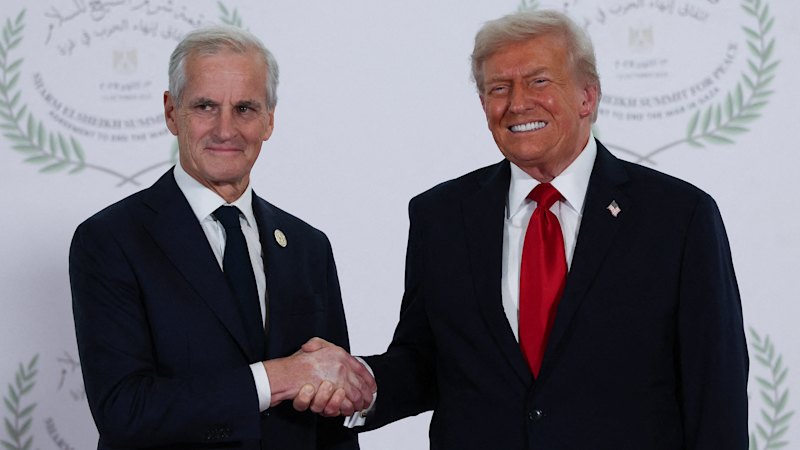
The ongoing diplomatic tensions between the United States and Europe have intensified following a leaked letter from President Donald Trump, in which he linked his demand for control over Greenland to his frustration over not receiving the Nobel Peace Prize. In a message to Norwegian Prime Minister Jonas Gahr Støre, Trump expressed that the committee’s decision to award the prize to Venezuelan activist María Corina Machado instead of him has altered his perspective on pursuing peace initiatives.
In the letter, Trump stated, “Considering your country decided not to give me the Nobel Peace Prize for having stopped 8 wars, I no longer feel an obligation to think purely of Peace.” He went on to assert that Denmark cannot adequately protect Greenland from potential threats posed by Russia and China. The President questioned Denmark’s claim to the territory, stating that historical agreements regarding ownership were vague at best. This assertion has raised concerns among European leaders regarding Trump’s willingness to take radical actions to assert his claims.
Trump’s remarks come at a time when tensions are simmering within NATO and among other allies. He has threatened to impose new tariffs of 10% on the United Kingdom and other NATO countries starting on February 1, 2024, escalating to 25% on June 1, 2024 if they do not support his Greenland ambitions. French President Emmanuel Macron has indicated that the European Union may consider retaliatory measures that could impact US exports valued at approximately €93 billion (around $162 billion).
The response from European leaders has been swift. Danish Prime Minister Mette Frederiksen condemned Trump’s tariff threats as “blackmail,” while Greenland’s Prime Minister Jens-Frederik Nielsen reiterated that Greenland is not for sale. A joint statement from leaders of the United Kingdom, France, Germany, Finland, Sweden, Norway, Denmark, and the Netherlands expressed solidarity with Denmark and Greenland, emphasizing their commitment to the region’s autonomy.
The leaked communication has provoked significant discussions about the potential for a trade war between the US and Europe. British Prime Minister Keir Starmer remarked that a tariff war would be detrimental to all parties involved, urging for a diplomatic solution that does not compromise Greenland’s status. Even Nigel Farage, a political ally of Trump, criticized the tariff threats as “wrong, bad, and very, very hurtful.”
Amid these developments, Finnish President Alexander Stubb has announced plans to meet with Trump during the upcoming World Economic Forum in Davos, where other prominent leaders, including NATO Secretary-General Mark Rutte and European Commission President Ursula von der Leyen, are also expected to engage in discussions about the escalating situation.
As the international community watches closely, the implications of Trump’s letter and the subsequent reactions from European leaders could reshape diplomatic relations and trade policies in the coming months. The meeting in Brussels on Thursday will further clarify Europe’s collective strategy in response to Trump’s assertive demands regarding Greenland and the broader implications for NATO and transatlantic relations.