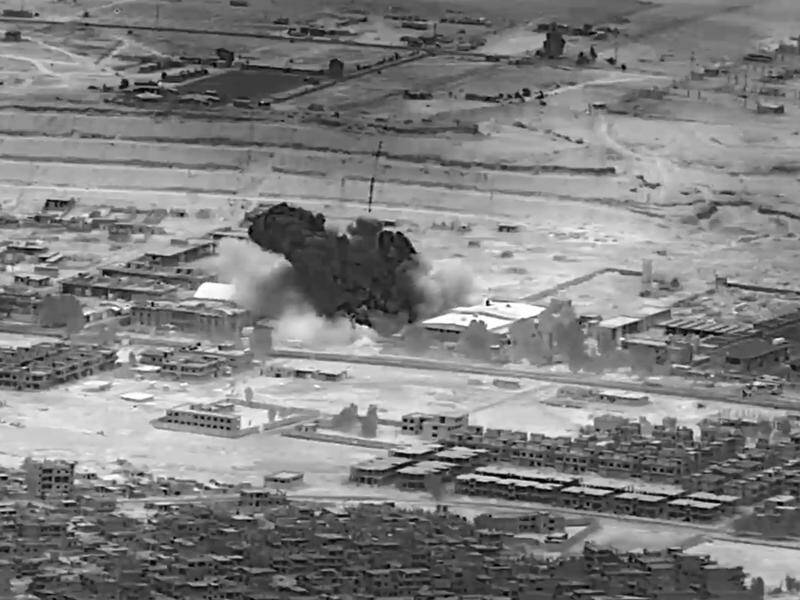
The United States military executed a series of airstrikes against multiple Islamic State targets in Syria on Friday, marking a significant escalation in response to a recent attack that left two US Army soldiers and a civilian interpreter dead. The strikes targeted locations across central Syria, demonstrating the US commitment to countering threats from the militant group.
This military action followed an attack on a convoy of American and Syrian forces in the central Syrian town of Palmyra on Saturday, where a suspected Islamic State member opened fire, resulting in casualties and injuries to three other US soldiers. A US official, who requested anonymity, characterized the airstrikes as a large-scale retaliation designed to address the growing dangers posed by the Islamic State.
Context of the Airstrikes
The US has been actively involved in military operations against the Islamic State in recent months, collaborating with local Syrian security forces. The recent attack against US personnel prompted President Donald Trump to vow a decisive response, underscoring the ongoing challenge of ensuring the safety of American forces stationed in the region.
These strikes are part of a broader strategy to disrupt the Islamic State’s operations in Syria, a country that has been ravaged by conflict for over a decade. The US-led coalition has routinely conducted airstrikes and ground operations targeting Islamic State militants, aiming to diminish their influence and capabilities.
Humanitarian Situation in Gaza
In a related story, a report from the Integrated Food Security Phase Classification (IPC) indicated that famine conditions in Gaza have subsided following improved access for humanitarian assistance. This development comes after a fragile ceasefire was established on October 10 between Israel and Hamas, allowing for increased food deliveries to the region.
The IPC’s assessment revealed that four months after declaring famine conditions affecting approximately 514,000 individuals in Gaza, the situation has stabilized. However, the IPC cautioned that without sustained humanitarian support and stability, the risk of famine could re-emerge, particularly if hostilities resume.
“Under a worst-case scenario, the entire Gaza Strip would be at risk of famine through mid-April 2026,” the IPC warned, highlighting the continuing humanitarian crisis in the enclave.
Israel maintains control over all access points to Gaza, and the Israeli military agency COGAT reported that between 600 and 800 trucks have been delivering aid daily since the ceasefire began. COGAT stated that food accounted for approximately 70 percent of the supplies entering Gaza.
Contrarily, the IPC criticized the report from COGAT, claiming it relies on incomplete data and misrepresents the actual humanitarian needs. The Israeli Foreign Ministry has defended its aid figures, asserting that the volume of humanitarian assistance has significantly increased since the onset of the truce, leading to a drop in food prices in Gaza.
The complex dynamics of aid distribution and the ongoing humanitarian crisis in Gaza reflect the region’s volatility and the challenges faced by aid agencies working to address urgent needs. As the situation develops, the international community remains vigilant in monitoring both the military and humanitarian landscapes in Syria and Gaza.