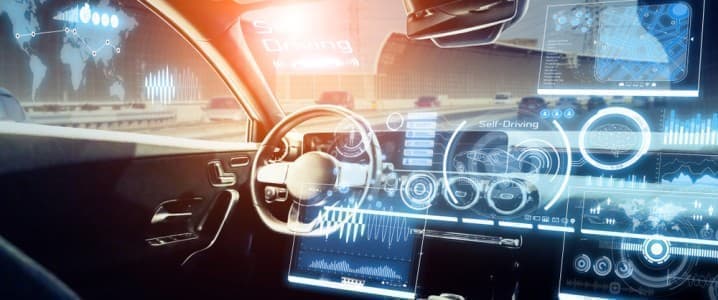
The race for self-driving cars is gaining momentum as automakers and technology companies collaborate to refine autonomous driving technologies. Recent developments indicate significant progress, yet the industry still faces considerable challenges that hinder the widespread adoption of fully autonomous vehicles.
Significant Innovations and Challenges in Autonomous Driving
Several cities have initiated pilot programs featuring autonomous taxis and buses, showcasing advancements in this cutting-edge technology. Companies like Waymo, formerly known as the Google self-driving project, have established themselves as leaders in the market, with plans for large-scale deployment of robotic taxis in 40 to 80 cities by 2035. The autonomous vehicle (AV) market is projected to grow at a compound annual growth rate (CAGR) of 5.95 percent from 2024 to 2030, reaching a value of $127.31 billion, according to data from Research and Markets.
Despite these optimistic forecasts, many automakers are currently offering limited levels of automation in their vehicles. Technologies such as adaptive cruise control and lane assistance are now standard in many models, placing them at around level 2 of automation. While companies like Tesla assert they have developed fully autonomous capabilities, definitions of what this entails vary significantly.
Advanced levels of automation are emerging, with Waymo’s sixth-generation driverless system operating in select U.S. cities at level 4 autonomy. This allows vehicles to navigate without human intervention in specific areas. Yet, the elusive level 5 automation, which would enable cars to operate in any traffic condition without a human present, remains unachieved.
Nvidia’s Role and Market Dynamics
The landscape is set to evolve further with Nvidia‘s recent announcement of a new technology platform for self-driving cars. At the CES tech conference in January 2024, Nvidia CEO Jensen Huang unveiled the Alpamayo, an open-source AI model designed to enhance the reasoning capabilities of AVs. The demonstration featured an AI-powered Mercedes-Benz navigating San Francisco with a passenger seated behind the wheel, hands in their lap, highlighting the potential for safer navigation in complex environments.
Huang emphasized that the Alpamayo platform marks a significant shift for Nvidia from being a compute provider to a platform provider for physical AI ecosystems. The company aims to partner with Mercedes-Benz to implement this advanced technology. However, Mercedes-Benz has recently decided to pause its Drive Pilot program, citing regulatory pressures, increasing costs, limited usability, and changing supplier dynamics. This program currently offers level 3 automation to U.S. consumers, requiring them to purchase specific hardware and pay an annual subscription fee of $2,500.
The cost of these technologies has limited consumer interest, despite their sophistication. The Drive Pilot system utilizes a combination of cameras, radar sensors, ultrasonic sensors, and lidar technology supplied by Luminar.
Nvidia’s vice president of the automotive team, Ali Kani, indicated that partial autonomous driving technology may debut in Europe this year, with plans for more advanced level 4 AVs potentially rolling out as early as next year. This suggests that Nvidia is expanding its focus beyond the U.S. market.
As more city governments and consumers express interest in self-driving vehicles, companies are responding with innovative technologies. Despite setbacks, the drive toward higher automation levels continues as stakeholders navigate regulatory frameworks and market demands. The coming years are likely to witness significant developments as the automotive industry aims to transform the driving experience.