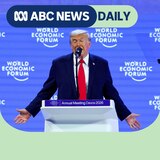
In a bold assertion of U.S. foreign policy, President Donald Trump has expressed a desire to assert control over Greenland, suggesting a purchase and earlier threatening tariffs against nations that opposed his ambitions. After negotiations, he has since dropped the tariff threat and ruled out military force, indicating a shift in strategy. This approach reflects a broader aim to reshape the geopolitical landscape of the Western Hemisphere.
Trump’s Vision of Dominance
Trump’s rhetoric has included a range of provocative statements regarding U.S. influence in the region. He has claimed that “for decades, other administrations have neglected or even contributed to these growing security threats in the Western Hemisphere.” In his view, the current administration is “reasserting American power in a very powerful way.” This sentiment underlines a strategy meant to reestablish U.S. dominance.
During a recent address, Trump proposed renaming the Gulf of Mexico to the “Gulf of America” and suggested reclaiming the Panama Canal. He characterized Greenland as an “enormous, unsecured island” that is part of North America, emphasizing its significance to U.S. territorial claims.
Monica Duffy Toft, a Professor of International Politics and Director of the Center for Strategic Studies at the Fletcher School at Tufts University, provided insights into Trump’s foreign policy during an interview. She described a “strong, muscular type of foreign policy” that is evident in the administration’s National Security Strategy, which aims to reassert U.S. influence in the Western Hemisphere.
Geopolitical Implications
Toft noted that Trump’s administration has transitioned from passive measures to overt coercion. This is exemplified by military actions in Venezuela, where the U.S. has shown a willingness to use force to achieve its objectives. “They’ve demonstrated through Venezuela the willingness to use force,” she stated, highlighting a significant shift in U.S. tactics.
Trump’s vision for global power dynamics divides the world into spheres of influence dominated by the United States, China, and Russia. Toft remarked that while Trump aspires to lead on the global stage, he faces the reality of significant competition from these powers, particularly as China emerges as a peer competitor. “Russia is still wreaking havoc in Ukraine,” she added, emphasizing the challenges the U.S. faces in asserting its influence.
During a recent speech, Canadian Prime Minister Mark Carney warned of an era marked by great power rivalry, suggesting that the traditional rules-based international order is fading. French President Emmanuel Macron echoed these concerns, characterizing the current geopolitical climate as a shift toward a world where imperial ambitions are resurfacing, and international law is often disregarded.
Toft explained that Trump’s approach could be seen as a new form of imperialism, where the sovereignty of smaller nations is compromised without outright annexation. She expressed concern about the risks of this strategy, questioning how much latitude smaller nations will have in navigating their foreign relations.
As Trump continues to implement his foreign policy, questions remain about its long-term viability. Toft pointed out that there is uncertainty about whether these changes will endure beyond Trump’s presidency, given their significant departure from established U.S. foreign policy norms.
Trump has also invoked the historical Monroe Doctrine, recently dubbing it the “Donroe Doctrine,” in an effort to reestablish U.S. dominance in the hemisphere. This doctrine, which initially aimed to prevent European interference in the Americas, has been reframed to suggest that the U.S. expects compliance from neighboring nations regarding its foreign policy directives.
Toft emphasized that Trump’s actions in Venezuela, including the attempted capture of its president, symbolize a test of this new doctrine. “The administration doesn’t seem to be done yet,” she observed, hinting at further ambitions in the region, including potential actions involving Cuba.
As the Trump administration navigates these complex geopolitical waters, the implications of its actions could be profound. Toft articulated three main reasons why Trump’s vision may falter: the lack of cooperative frameworks akin to those established during World War II, the autocratic nature of the leadership Trump admires, and the interconnectedness of the modern world that transcends geographical boundaries.
In the context of U.S.-Australia relations, Toft noted the challenges presented by the dual pressures from China and the United States. Australia, with its strong military ties to the U.S. and economic connections to China, faces a complex balancing act. “They’re going to have to hedge between the two,” she advised.
As Trump continues to pursue his ambitious agenda, the potential dangers of these policies raise concerns. Toft expressed her apprehension regarding the risks involved, suggesting that the current administration may not fully grasp the implications of its actions. “They’re opening up a whole pile of risks that I’m not sure they’re even aware of,” she concluded.
As the situation evolves, the international community will be watching closely to understand the future trajectory of U.S. foreign policy under Trump’s leadership and its impact on global stability.