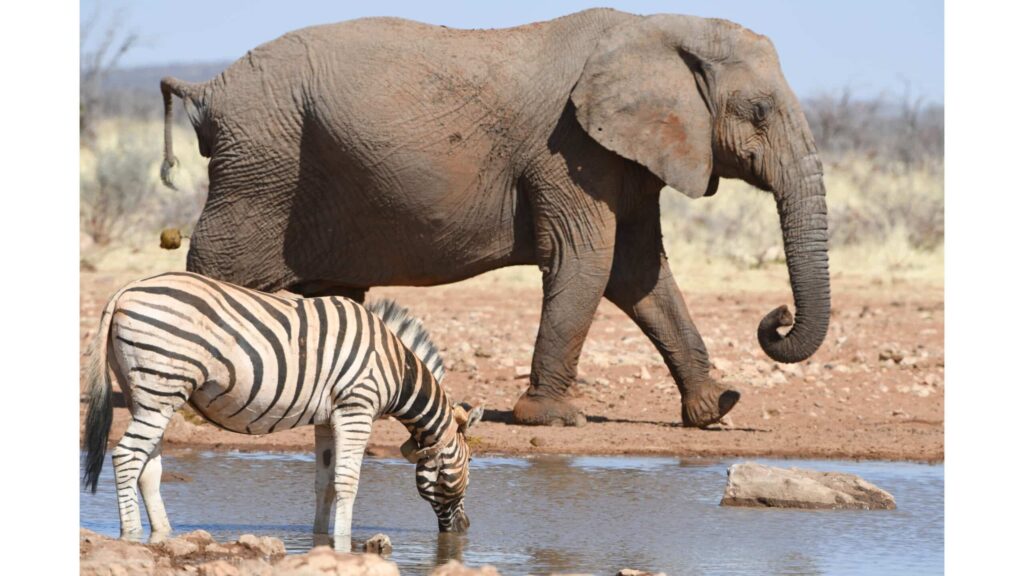
A recent study examining wild African herbivores has illuminated how environmental conditions influence the evolution of gut microbiomes, beyond just dietary and anatomical factors. Researchers from North Carolina State University and Northern Michigan University focused on the relationship between the gut microbiomes of these animals and their surrounding ecosystem in Namibia’s Etosha National Park.
The research, co-authored by Erin McKenney, an assistant professor of applied ecology, and Rylee Jensen, a recent master’s graduate, sought to understand the concept of phylosymbiosis. This ecological theory posits that as species evolve and diverge, their gut microbiomes will also evolve in a predictable manner. Jensen explained, “Our work here was focused on determining whether there was evidence of phylosymbiosis among herbivore species in an arid ecosystem – and whether we could identify any factors that may play a role in fostering or inhibiting phylosymbiosis.”
The team collected fresh fecal samples from 11 herbivore species in the park, including African elephants, Angolan giraffes, and various antelope species. Using DNA extraction and sequencing techniques, they identified the types and abundance of bacteria present in the gut microbiomes of these animals.
The findings revealed significant contrasts among the species studied. “We found little or no evidence of phylosymbiosis in six of the species,” Jensen noted. “However, there were patterns of phylosymbiosis for five species: red hartebeest, blue wildebeest, gemsbok, impala, and springbok.” These five species are all bovids, characterized by complex stomachs suited for digesting fibrous plant material.
The evidence of phylosymbiosis in these closely related species suggests a possible evolutionary link, differing from previous studies conducted in more temperate regions of Africa. “This suggests the actual environment itself may be playing a role in masking or revealing phylosymbiosis in the gut microbiome,” Jensen added.
Erin McKenney further elaborated on the implications of the findings, stating, “Areas that receive more rainfall tend to have more lush and diverse vegetation, which may support greater gut microbial diversity.” In contrast, drier environments like Etosha may strip away microbial species not specifically adapted to the local herbivores and their limited diet.
The study’s authors speculate that the clearer detection of phylosymbiosis in arid ecosystems could stem from a reduced number of microbial species, allowing researchers to identify adaptations more easily. Jensen emphasized the uniqueness of the bovids studied, as they possess distinct microbial communities compared to other herbivores.
As climate change continues to impact ecosystems globally, the research holds significant implications. “As ecosystems around the world shift due to human-mediated climate change, such as desert expansion, the microbial community within Etosha’s herbivore guild may serve as a bellwether for what we might expect to find among herbivore communities in ecosystems becoming more arid,” said Diana Lafferty, co-author and associate professor at Northern Michigan University.
“This study raises a lot of questions that can be explored in future work, particularly regarding the role that environmental factors play in shaping the evolution of gut microbiomes,” McKenney concluded. “Given some of the dramatic ecological shifts we are experiencing due to climate change, these questions are more important than ever.”
The paper, titled “Phylogenetic influence on gut microbiome diversity within an African herbivore community,” is published open access in the journal BMC Ecology and Evolution. The research was co-authored by Claudine Cloete, chief conservation scientist at the Etosha Ecological Institute, and James Beasley, the Terrell Distinguished Professor of Wildlife Management at the University of Georgia.