Researchers at the University of Rochester have uncovered a significant mechanism by which Earth’s atmosphere is gradually transferring particles to the Moon. This phenomenon, which has been occurring for billions of years, suggests that our planet’s magnetic field plays a crucial role in this process. The findings highlight the complex relationship between Earth and its lunar neighbor.
The study, published in the journal Nature Communications Earth & Environment, challenges previous assumptions that Earth’s magnetic field would prevent atmospheric particles from reaching the Moon. For decades, scientists believed that once the magnetic field developed, it would trap most atmospheric particles, making such a transfer unlikely. However, the research team simulated two different scenarios—one depicting an ‘early Earth’ without a magnetic field and a stronger solar wind, and another representing a ‘modern Earth’ with a robust magnetic field and a weaker solar wind. To their surprise, the modern Earth model aligned more closely with the observed data.
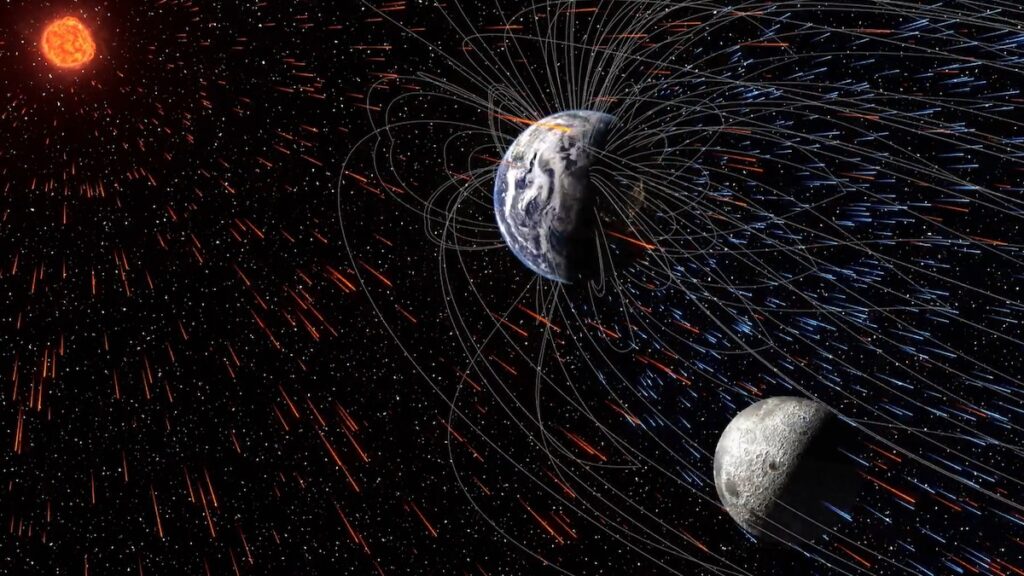
The team discovered that when the solar wind interacts with Earth’s atmosphere, it dislodges charged particles. These particles then travel along the planet’s magnetic field lines before reaching the Moon. Earth’s magnetosphere, shaped more like a comet’s tail than a perfect sphere, allows particles to be deposited on the lunar surface as the Moon traverses through this tail.
Previous studies have suggested that this mechanism could also account for the delivery of oxygen to the Moon, which may lead to the formation of water and rust on its surface. The ongoing transfer of atmospheric particles over billions of years has potentially created a time capsule of historical data preserved in the lunar regolith—the fine, rocky dust covering the Moon. This accumulation of volatile elements, such as nitrogen, has been detected since the Apollo missions returned lunar samples to Earth.
The implications of this research extend beyond mere scientific curiosity. The presence of these particles may provide insights into the evolution of Earth’s atmosphere and its historical changes. As scientists continue to explore the Moon’s surface, they may unearth valuable information that contributes to our understanding of planetary atmospheres and their interactions.
This groundbreaking study illuminates the intricate dynamics between Earth and the Moon, challenging long-held beliefs and opening new avenues for research in planetary science. As our understanding of these celestial interactions deepens, the potential for further discoveries about both our planet and its lunar companion grows exponentially.