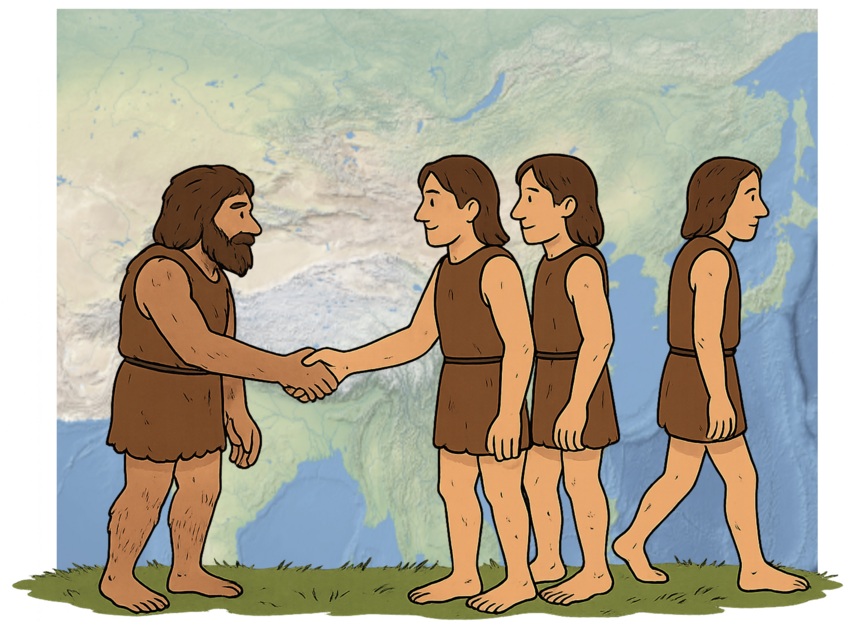
Researchers have uncovered critical insights into the interactions between early East Asians and Denisovans, a group of ancient hominins. Their findings, published in a recent study, reveal a complex pattern of Denisovan ancestry in modern humans that spans over the last 40,000 years.
This pioneering research, led by a team at the Max Planck Institute for Evolutionary Anthropology, involved a systematic paleogenetic analysis of DNA segments inherited from Denisovans. By studying ancient genomes from various locations across Eurasia, the researchers traced Denisovan ancestry, shedding light on the historical dynamics between these ancient groups and modern populations.
Tianyuan individual, an ancient human specimen from China dating back approximately 40,000 years, exhibited the highest level of Denisovan ancestry among all ancient and contemporary humans analyzed, with over 0.2 percent Denisovan DNA. This finding is significant as it suggests a shared history of contact with Denisovans among early East Asian populations.
The study indicates that gene flow from populations with lesser or no Denisovan ancestry diluted the Denisovan genetic contributions in early East Asians. “Denisovan DNA represents a powerful marker to reconstruct population history,” noted Stéphane Peyrégne, a population geneticist who co-supervised the study. This genetic evidence is vital for understanding how populations moved and interacted throughout history.
Denisovan Legacy in West Eurasia and the Jomon People
The research also highlights how Denisovan ancestry reached West Eurasia, albeit at minimal levels. This migration likely occurred through the movement of populations from Eastern Eurasia starting before 12,000 years ago.
One of the more surprising findings pertains to the ancient Jomon people, who inhabited the Japanese archipelago and the Ryukyu/Okinawa islands. Despite their contribution to the ancestry of present-day Japanese, the Jomon people carried the lowest levels of Denisovan ancestry among East Asians. Their Denisovan DNA can be traced back to later gene flow from mainland populations, indicating they descended from a lineage that did not encounter Denisovans directly.
Lead author Jiaqi Yang explained, “This suggests that some groups took different routes during the early dispersals in East Asia, or Denisovans were so sparsely distributed that interactions with them were rare.” The implications of these findings enhance our understanding of the early human diaspora in East Asia and the varying experiences of different populations.
Despite the study’s advances, the origins of the Jomon and other East Asian groups during the Paleolithic remain largely unknown. Ongoing research into ancient genomic data is expected to further clarify the timing and nature of interactions between modern humans and Denisovans.
This research underscores the intricate and regionally diverse ancestral history shared by modern humans and Denisovans, marking a significant step forward in the field of human evolutionary studies.