



The highly anticipated return of Formula 1 kicks off with the Australian Grand Prix on March 17, 2024, amidst significant changes that could reshape the competition. The new regulations introduced this season promise to create a dynamic racing environment, yet they have sparked concerns among some of the sport’s top drivers regarding their impact on driving styles and strategies.
Max Verstappen, the four-time world champion, expressed his frustrations during pre-season testing, describing the new cars as “no fun.” He hinted that these changes might even lead him to consider retirement. Seven-time champion Lewis Hamilton echoed similar sentiments, stating that the complexity of the new regulations may alienate fans who find it hard to follow the intricacies of the sport.
The stakes are particularly high for Formula 1 this season. The sport has expanded rapidly in the last decade, focusing on enhancing drivers’ personalities rather than the underlying technology. As F1 chief executive Stefano Domenicali remarked at recent testing, “We need to stay calm because, as always when there is something happening with a new regulation, there’s always the doubt that everything is wrong.”
Top Teams Maintain Strong Position
Despite the regulatory shake-up, the top four teams—Mercedes, Ferrari, McLaren, and Red Bull—showed promising performances during testing. According to team principal Zak Brown, these “big four” are likely to remain dominant in 2026 as well. Early assessments indicate that all teams are roughly comparable in pace, with Mercedes and Ferrari appearing to hold a slight advantage during race simulations.
Ferrari made headlines during testing by unveiling a rear wing designed to enhance straight-line speed and a unique mini-wing positioned behind the exhaust. They also excelled in practice starts, with some rivals, particularly Mercedes, struggling to achieve a quick getaway. Meanwhile, Red Bull has been praised for its adept handling of electrical power technology, a crucial element under the new regulations.
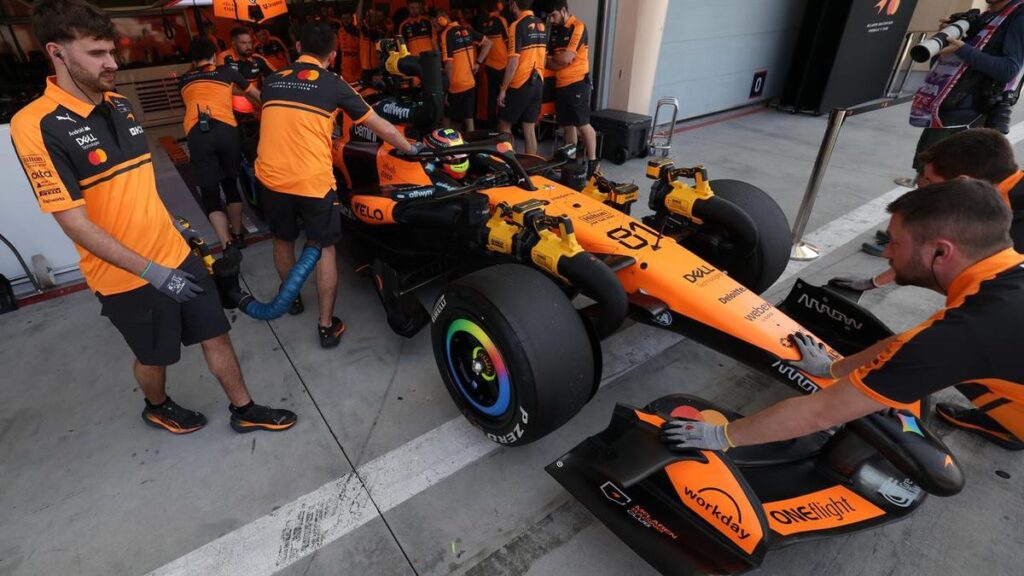
The testing sessions also highlighted the potential of McLaren’s lineup, featuring Lando Norris and Oscar Piastri, who consistently demonstrated strength on the track. Mercedes is banking on a combination of power and reliability, positioning George Russell as a strong contender for the championship. Notably, the performance of Mercedes’ engine has generated speculation regarding its legality, but the team maintains that their design adheres to all regulations.
Challenges and Innovations Ahead
Some teams opted to sacrifice performance in 2025 to secure advantages for the following season, a strategy that has not paid off. Aston Martin, despite having the renowned designer Adrian Newey on board, struggled with reliability and speed, often falling behind the new team, Cadillac. Williams and Alpine have also faced difficulties, though Haas shows potential for better performance.
The FIA is emphasizing a balanced approach between engine power and electrical hybrid technology, which will require drivers to adapt their techniques. During pre-season testing, drivers were observed revving their engines for rapid launches while managing their energy output on straights. The hybrid system becomes active only at speeds above 50 kph, complicating standing starts and necessitating adjustments to the procedure to ensure efficiency.
Ferrari appears to have preemptively addressed this challenge, having designed their engine for quick launches off the grid. Hamilton made a memorable impression by overtaking four cars in a practice start in Bahrain, an ability that could prove vital if overtaking remains as challenging as anticipated.
Looking ahead, the Australian Grand Prix at Melbourne’s Albert Park will test these new dynamics, with teams facing the possibility of cars becoming “energy-starved” on tracks that lack heavy braking zones. The newly introduced “overtake mode” could prove ineffective if drivers cannot fully charge their batteries, leaving them vulnerable during critical moments.
Cadillac enters the fray as the 11th team, featuring veteran drivers Sergio Perez and Valtteri Bottas, but they will need time to adapt after a lackluster pre-season. Additionally, the Spanish Grand Prix will relocate from Barcelona to Madrid’s new street circuit, while Imola will no longer host a race, with Barcelona remaining on the calendar as the Barcelona-Catalunya Grand Prix.
As Formula 1 embarks on this exciting new season, teams and fans alike prepare for what promises to be a thrilling, unpredictable journey in the pursuit of speed, strategy, and success.