




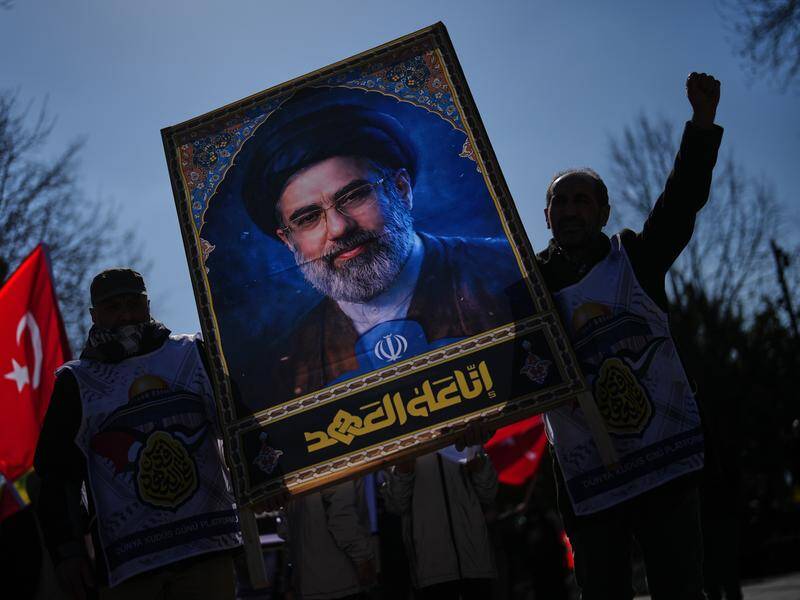
The United States has reported that Iran’s new Supreme Leader, Mojtaba Khamenei, is wounded and likely disfigured following nearly two weeks of military confrontations involving US and Israeli forces. US Defence Secretary Pete Hegseth raised questions about Khamenei’s capability to govern in light of the severe attacks that have notably affected his family, resulting in the deaths of several relatives, including his father and wife.
Since the onset of the conflict, Khamenei has not been seen publicly. His first communication came through a statement read by a television presenter on Thursday, in which he vowed to maintain the closure of the Strait of Hormuz and urged neighboring countries to close US military bases on their territories to avoid Iranian retaliation. Hegseth commented on the absence of visual or audio evidence of Khamenei’s condition, suggesting that the lack of a video statement indicated his weakened state: “We know the new so-called not so supreme leader is wounded and likely disfigured,” he said during a briefing.
“A weak one, actually, but there was no voice and there was no video. It was a written statement,”
Hegseth emphasized the US’s aggressive military stance, declaring, “We will keep pressing, keep pushing, keep advancing. No quarter, no mercy for our enemy.” This declaration raised concerns regarding the legality of such a military approach. According to the International Committee of the Red Cross (ICRC), international humanitarian law prohibits orders that lead to the targeting of surrendered individuals.
In the past two weeks, US forces have targeted over 6,000 locations in Iran. Reports indicate that the Pentagon is mobilizing additional military assets to the region, including the USS Tripoli, an amphibious assault ship capable of deploying fighter jets. This ship is currently stationed in the Asia-Pacific region but is being redirected to enhance US presence in the ongoing conflict.
President Donald Trump has previously stated that the US will intensify its military operations against Iran in the coming days. Following the announcement of a partial waiver for purchases of sanctioned Russian oil, Trump signaled that the US aims to stabilize fluctuating fuel prices attributed to the conflict. Despite his comments suggesting that the war might be “complete,” he later reiterated a commitment to escort vessels in the Strait of Hormuz if necessary.
Since the start of hostilities, approximately 2,000 fatalities have been reported, predominantly occurring in Iran, with increasing casualties also noted in Lebanon and the Gulf region. This escalation marks a significant shift, placing the Gulf at the forefront of conflict dynamics in the Middle East.
In a notable move, the US government is offering up to $10 million for information on senior Iranian military and intelligence officials, including the new Supreme Leader Khamenei. The reward targets ten individuals associated with Iran’s Islamic Revolutionary Guard Corps (IRGC), an organization established post-Iran’s 1979 Islamic Revolution, known for its loyalty to the supreme leader and its role in safeguarding the Shi’ite clerical establishment.
As the situation develops, the implications of this conflict on regional stability and international relations remain a focal point of concern for global observers.
