




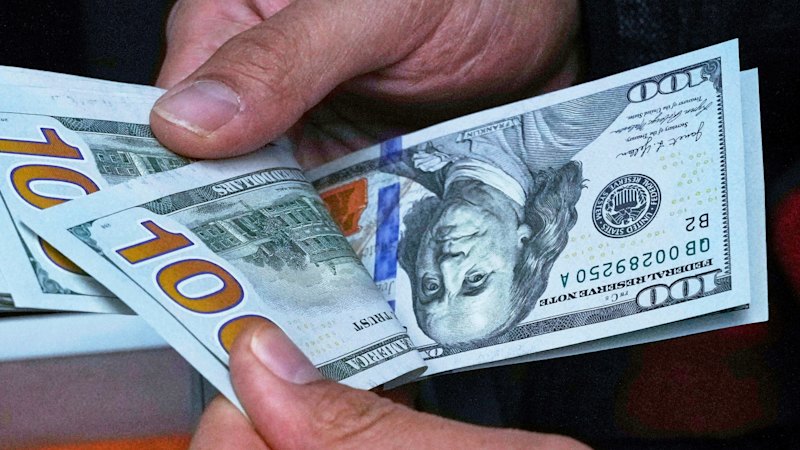
UPDATE: The US dollar has plunged to its weakest level in nearly four years, driven by rising policy risks and a surge in the Japanese yen. The Bloomberg Dollar Spot Index fell by as much as 0.7% on October 3, 2023, marking its lowest point since March 2022. This drop marks the fourth consecutive day of losses, positioning the dollar for its worst stretch since former President Donald Trump announced universal tariffs in April 2022.
This decline is a direct result of growing investor caution regarding unpredictable policymaking in Washington, including Trump’s controversial threats, such as plans to acquire Greenland. Concerns about the independence of the Federal Reserve, a ballooning budget deficit, and increasing political polarization have further eroded confidence in the dollar.
“Structural drags on the dollar—fading confidence in US trade and security policy, politicization of the Fed, and deteriorating US fiscal credibility—could outweigh the more neutral cyclical backdrop,” stated Elias Haddad, global head of markets strategy at Brown Brothers Harriman & Co.
The dollar’s weakness has sent ripples through global currency markets. The euro soared to its highest level since June 2021, reaching $1.1972, while the British pound climbed to $1.3791, its strongest since October 2021. The Japanese yen strengthened, trading at 153.03 against the dollar, following indications from Japanese officials of potential market intervention.
Japanese Finance Minister Satsuki Katayama emphasized the government’s readiness to act against volatile currency movements, affirming coordination with US authorities if necessary. This has reopened discussions about possible coordinated currency interventions aimed at guiding the dollar lower against key trading partners.
Reports indicate that the Federal Reserve Bank of New York recently contacted financial institutions to assess the yen’s exchange rate, a preliminary move often signaling impending interventions. Market analysts believe that this rate-checking contributed to the dollar’s continued decline.
As a result of the dollar’s fall, an index tracking emerging-market currencies has also seen gains for four consecutive days, with 16 out of 22 developing currencies tracked by Bloomberg rising against the greenback. This upward trend reflects a record high for the gauge, as investors seek better returns outside the US.
“Washington’s protectionist pivot and diminished security commitments are pushing other nations to boost defense spending and hone their competitive edge,” noted Karl Schamotta, chief market strategist at Corpay. This shift is compressing the growth and interest rate differentials that once favored the dollar.
The sentiment surrounding US dollar debasement is gaining traction among investors, with significant turnover in G-10 currency options this week. Analysts suggest that traders are hedging against a deeper sell-off in the dollar, as the premium for short-dated options has reached its highest level since 2011.
Heavy trading volumes also underscore the negative outlook for the dollar, with Monday’s trading through the Depository Trust & Clearing Corporation hitting the second-highest record ever, only surpassed by the sell-off on April 3, 2023.
UPDATE: Recent US economic data points to solid performance, but traders expect the Fed to maintain current rates in Wednesday’s meeting. Despite this, market forecasts suggest nearly two quarter-point cuts by year-end, contrasting with expectations for other major central banks to hold steady or raise rates.
The anticipated appointment of a new Federal Reserve chairman by Trump may also impact the dollar’s future, with speculation that the new leader might favor lower borrowing costs. Additionally, the looming threat of a government shutdown, as Democrats push to block a spending package, adds to the uncertainty surrounding the dollar.
“With a partial government shutdown now possible, there are still significant concerns for dollar bulls,” cautioned Kit Juckes, head of foreign-exchange strategy at Societe Generale. The trajectory of US growth remains critical in determining how much the Fed may ease, significantly influencing the dollar’s fate moving forward.
Stay tuned for more updates on this developing story as market conditions continue to evolve.
