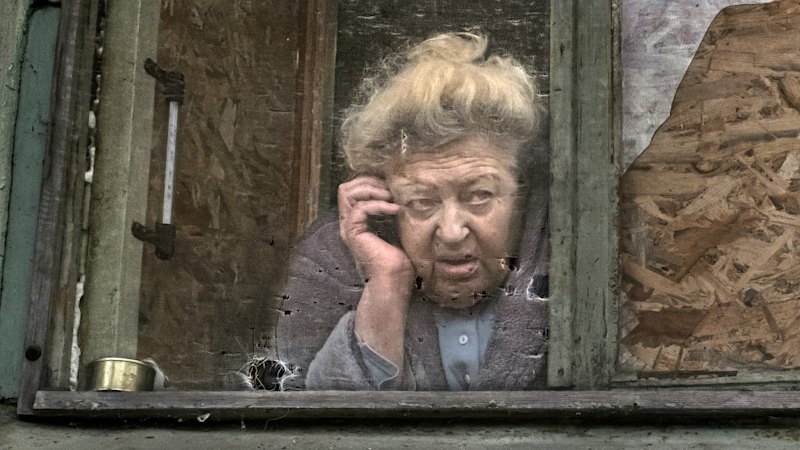
The city of Kherson in southern Ukraine has become a perilous environment, where residents face the constant threat of drone attacks. With the ongoing conflict intensifying, the risks associated with daily activities are alarmingly high. Tanya Leshchenko, a mother of five, exemplifies the struggle faced by many as she navigates this treacherous reality. Before stepping outside to pick up her daughter, she consults an online chat group that provides warnings about incoming drones, underscoring the grim atmosphere that has enveloped the community.
Kherson, a city characterized by its tree-lined boulevards and historical architecture, has witnessed a significant decline in its population, now reduced to approximately 65,000 as many residents have fled the violence. The city lies within range of Russian quadcopter drones, which are launched from occupied territories across the Dnieper River. According to local authorities, around 200 civilians have lost their lives, and 2,000 have been injured over the past year due to these aerial assaults.
The drone attacks have taken on a chilling moniker—referred to locally as a “human safari.” Civilians have become targets, with drones dropping grenades on unsuspecting individuals going about their daily routines. The United Nations has condemned these actions, categorizing them as war crimes.
As life continues below ground, essential services have relocated to underground facilities. Hospitals, government offices, and even schools now operate from basements, as outdoor activities have become too dangerous. The community has adapted by creating underground activity spaces where children can engage in dance, art, and socialization, with some classes even named “United by Love.”
In response to the drone threat, Kherson has implemented various defense measures, though none are entirely foolproof. The military has erected jamming antennas along the riverbank, while nets designed to intercept drones have been installed over major thoroughfares. Additionally, 250 concrete escape chambers have been constructed on footpaths, providing some measure of safety for pedestrians.
Council workers now carry handheld drone detectors as they attempt to repair damage caused by previous attacks. These devices intercept feeds from the drones’ cameras, revealing what the operators see when they target civilians. Yaroslav Shanko, the city’s military-civilian administrator, recalls a close encounter when his driver had to evade a drone by speeding through the streets at nearly 130 km/h.
Rights groups have warned that cities like Kherson may serve as a blueprint for future conflicts, as small quadcopter drones have revolutionized the landscape of warfare. Belkis Wille, an associate director at Human Rights Watch, notes that the democratization of drone technology has made it easier for armed groups to target civilians. “Kherson is the clearest example of a campaign to target civilians with quadcopter drones,” Wille states, emphasizing the potential for similar scenarios to emerge in other conflict zones.
The impact of war on Kherson is profound. The city has faced relentless hardship, enduring occupation by Russian forces and subsequent artillery attacks. As conflict escalated, the introduction of drone warfare has added another layer of danger. Oleh Pinchuk, a local surgeon, points out that injuries from drone attacks have become so prevalent that residents have nearly forgotten about car accidents.
Survivors recount harrowing experiences of being hunted by drones. Mykola Hyadamaka, a retired driver, recalls a near-miss when he was struck by shrapnel while fumbling to enter his home. “There is no escape,” he states from his hospital bed, encapsulating the despair felt by many. Similarly, Serhiy Schevchenko, a plumber, describes a drone pursuing him around a tree before detonating nearby.
For children, the underground centers have become a rare refuge. Daria, an 11-year-old, recalls how she used to hide under trees during drone flyovers. Although many families have left Kherson, Tanya Leshchenko has chosen to stay, feeling that her family has nowhere else to go. After reaching the bus stop, she finds comfort in a concrete shelter, checking the chat group for updates before walking home with her daughter, Alyona.
As the conflict continues, Kherson stands as a stark reminder of the devastating impact of modern warfare on civilian life. The blend of technology and violence presents new challenges and dangers, leaving many to navigate a precarious existence amid the omnipresent threat of drone attacks.