



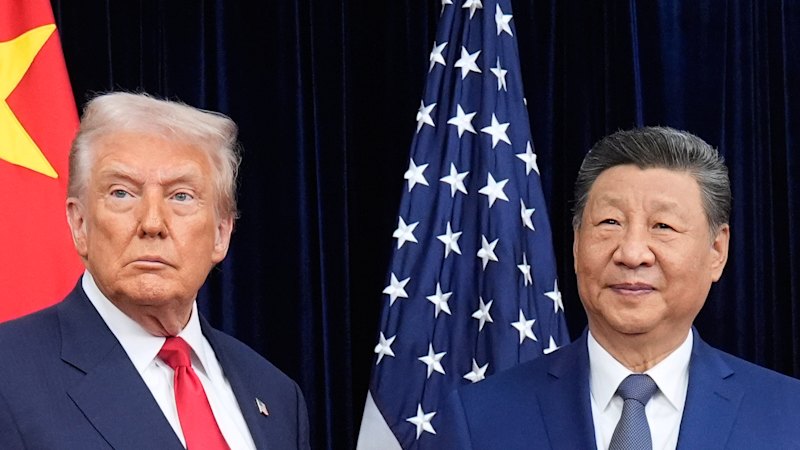
A recent ruling by the US Supreme Court has limited President Donald Trump‘s ability to impose tariffs, presenting a significant challenge just weeks before his scheduled meeting with Xi Jinping in April 2024. The decision invalidates tariffs previously enacted under emergency powers legislation, raising concerns among analysts that it may diminish Trump’s trade leverage against China, especially as he prepares for the upcoming midterm elections.
According to Shi Yinhong, a professor at Renmin University, this ruling has “weakened Trump’s trade leverage vis-a-vis the Chinese side.” As the political landscape shifts, Trump faces increasing constraints in negotiations, a situation that could influence voter sentiment as the November elections approach. Shane Oliver, chief economist at AMP, pointed out that the United States has been compelled to resume trade discussions, while China has adopted a more patient approach, suggesting that the balance of power may be tilting in Beijing’s favor.
Trade tensions between the US and China escalated sharply after Trump’s return to office in 2025, marked by a new wave of tariffs on Chinese goods, including a notable 20 percent levy tied to fentanyl flows. At various points, effective tariff rates on Chinese exports reached estimates between 35 percent and 50 percent. In response, Beijing initiated countermeasures, including restrictions on US agricultural imports and export controls on critical minerals, rekindling fears of a full-scale trade war.
The standoff began to stabilize late last year, following a meeting between Xi and Trump in South Korea. This meeting resulted in some concessions, particularly regarding politically sensitive exports that are crucial for Trump’s electoral base in the Midwest. With the midterm elections approaching, Oliver emphasized that Trump’s negotiating position is significantly weaker compared to Xi, noting that Congress has shown reluctance to support extended tariff measures.
China’s leadership, operating on a longer political cycle, is less constrained by immediate electoral pressures. Carolin Kautz, a China analyst at SinoVise, stated, “China takes a long view. It doesn’t have a political cycle.” Despite a slowdown in economic growth, which is expected to be around 4 percent to 5 percent, China has successfully diversified its markets. While exports to the US have seen a decline, shipments to regions such as South-East Asia and Latin America have increased, demonstrating the effectiveness of China’s long-term strategy.
This diversification has positioned China in a relatively comfortable spot regarding exports, allowing it to approach the upcoming meeting with less urgency for concessions. Oliver noted that China is not desperate for a deal, as its export strategies have effectively mitigated the impact of US tariffs.
Nevertheless, China faces its own set of challenges. Domestic demand remains sluggish, characterized by low consumer spending and weakened property investments. Shi warned that China’s financial capacity has been “steadily deteriorating,” which limits its ability to make substantial concessions in negotiations. He remarked that the country has “quite limited financial means and geopolitical leeway.”
Market analysts appear to be betting against a return to the high tariff rates seen during last year’s intense trade conflict. For Beijing, even a symbolic agreement may suffice. Kautz suggested that if China can leave the meeting with an image of success, perhaps through token concessions like soybeans, it would consider the engagement a win.
As the meeting approaches, both sides will be navigating a complex landscape of domestic pressures and international expectations, with the recent Supreme Court ruling adding another layer of uncertainty to the negotiations.