




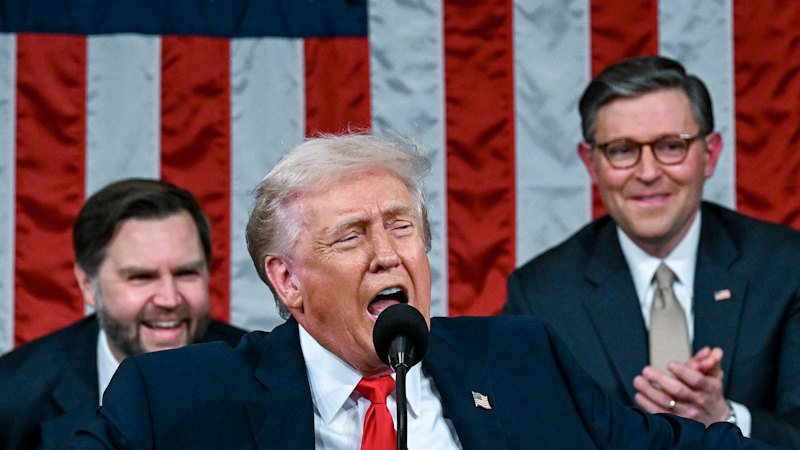
Former President Donald Trump delivered a lengthy State of the Union address on February 25, 2026, lasting 108 minutes, during which he asserted that the United States is on a path to unprecedented success. Despite his assertions of triumph, public approval ratings indicate significant dissatisfaction among voters. Trump’s speech covered a range of topics, from the economy to immigration and foreign policy, with a central message that the nation is “winning so much” under his leadership.
In an effort to galvanize support for the Republican Party ahead of the November midterm elections, Trump claimed his administration has revitalized the economy. However, the veracity of his statements warrants closer examination.
Examining Trump’s Claims
One of Trump’s prominent assertions was, “When I last spoke in this chamber 12 months ago, I had just inherited a nation in crisis, with a stagnant economy.” Fact-checking reveals this to be misleading. While many voters expressed concerns about inflation in the 2024 election, the US economy actually grew by 2.8 percent in 2024, surpassing the 2.2 percent growth rate observed in the prior year.
Trump also claimed, “Incomes are rising fast, the roaring economy is roaring like never before.” This statement faces scrutiny as well. After-tax incomes, adjusted for inflation, experienced a slight increase of only 0.9 percent in 2025, a decline from the 2.2 percent increase seen in 2024. The slowdown in wage growth is attributed to reduced hiring by companies, affecting workers’ earning potential.
Another bold claim involved investments, with Trump stating, “I secured commitments for more than $18 trillion pouring in from all over the globe.” This figure appears exaggerated, as the White House’s own data cites a much lower amount of $9.6 trillion, which includes commitments made during the Biden administration. A study released in January raised doubts about the likelihood of even $5 trillion in investment commitments materializing.
Understanding Employment and Crime Rates
Trump asserted, “More Americans are working today than at any time in the history of our country.” While the total number of employed Americans has indeed reached a record high due to population growth, the proportion of working Americans has declined over the past 25 years. The percentage peaked at 64.7 percent in April 2000, dropping to 59.8 percent as of January 2026.
On crime, Trump claimed, “Last year, the murder rate saw its single largest decline in recorded history.” This assertion misrepresents trends in violent crime. While a 21 percent decrease in homicides was reported in a January study by the Council on Criminal Justice, crime had already been decreasing prior to Trump’s address.
Trump’s remarks about immigration included, “We will always allow people to come in legally, people that will love our country and will work hard to maintain our country.” Contrarily, his administration has implemented numerous restrictions on immigration, including suspending the refugee program on his first day in office.
His tax policy claims also raised questions. Trump stated, “With the great big beautiful bill, we gave you no tax on tips, no tax on overtime and no tax on Social Security.” This assertion fails to account for the complexity of tax benefits, which are not uniformly applicable to all Social Security beneficiaries.
Finally, Trump claimed, “The revolution that began in 1776 has not ended,” inaccurately stating the timeline of the American Revolution. The American Revolution commenced in April 1775, culminating in independence in 1776.
As the political landscape shifts ahead of the midterm elections, scrutinizing statements from political leaders remains paramount for informed voter decisions. This analysis highlights the importance of verifying claims against factual data, ensuring voters have accurate information as they head to the polls.