




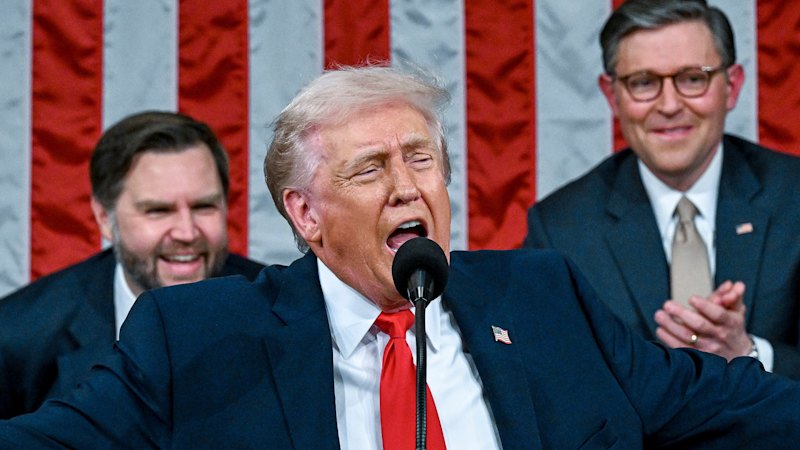
Donald Trump delivered an extensive State of the Union address on February 25, 2026, lasting over an hour and 45 minutes. The speech, while lengthy, largely revisited familiar themes and policies, lacking significant new content. Trump emphasized the nation’s economic recovery, secure borders, and low crime rates, declaring, “The state of our union is strong,” and claimed, “Our country is winning again – in fact, we’re winning so much that we really don’t know what to do about it.”
The address, characterized as a “greatest hits tour” by some observers, included familiar talking points such as lower petrol prices and the Dow Jones Industrial Average surpassing 50,000. Despite Trump’s optimism, polls indicate that many Americans do not share his positive assessment of the economy.
Trump did introduce a new initiative aimed at American workers who lack access to employer-sponsored retirement plans. Starting next year, he proposed a retirement savings plan that includes a government contribution of up to $1,000 annually. This initiative appears inspired by Australia’s superannuation system, which Trump has praised in the past.
Interactive Moments and Political Tensions
One of the more engaging aspects of Trump’s address involved his interactions with guests in the public gallery, transforming a conventional speech into an interactive event. He recognized the gold medal-winning men’s hockey team from the Winter Olympics in Italy, receiving enthusiastic applause from the audience.
In a poignant moment, Trump awarded the Medal of Honor to Royce Williams, a 100-year-old naval aviator and Korean War veteran. The chamber rose in applause as Williams humbly acknowledged the honor, illustrating a shared moment of national pride.
Yet, the address also highlighted political divides. Trump pointed out Anna Zarutska, the mother of a Ukrainian refugee who was tragically murdered in North Carolina. While Republicans stood in support, many Democrats remained seated, prompting Trump to question their lack of response, saying, “How do you not stand?”
Trump further emphasized a tough stance on immigration, urging the chamber to stand if they agreed that “the first duty of the American government is to protect American citizens – not illegal aliens.” Once again, Democrats remained seated, a visual that Trump’s advisors quickly shared on social media, framing it as evidence of the opposition’s disconnect with American values.
A Balancing Act of Emotion and Policy
The State of the Union is typically a highly orchestrated event, and Trump’s performance reflected some customary political restraint. He largely avoided contentious remarks directed at the Supreme Court justices present, referring to their decision to strike down his tariffs as “unfortunate” and “disappointing.”
While some viewers may have found this more measured approach reassuring, others questioned whether it diluted the energetic style that has characterized Trump’s political persona. As the speech progressed, many Democrats exited the chamber, with others visibly demonstrating their boredom.
Despite any criticisms regarding substance, Trump’s ability to engage the audience through personal stories and recognitions helped mitigate what could have been a lengthy, mundane address. By spotlighting achievements and honoring individuals, he showcased a side of American life that resonates with many, reinforcing his skills as a captivating television performer.
The lasting impact of this address on public opinion remains uncertain. However, Trump’s interactions and policy announcements reflected his continued effort to connect with the American populace, even as the political landscape becomes increasingly polarized.