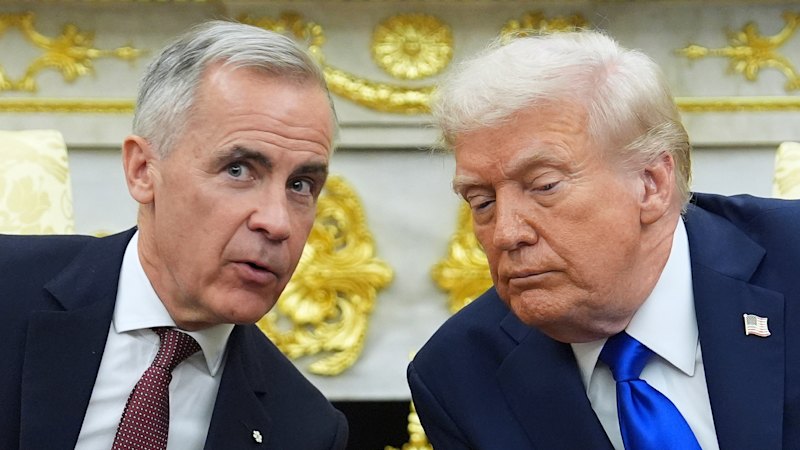
United States President Donald Trump has issued a stark warning to Canada, threatening to impose a 100% tariff on all Canadian exports to the US if the country proceeds with a trade agreement with China. This escalating confrontation highlights deteriorating relations between the two neighboring countries and reflects broader tensions in international trade.
In a recent social media post, Trump expressed his disapproval of Canadian Prime Minister Mark Carney, referring to him as “Governor Carney.” He accused Canada of being “sorely mistaken” for allowing China to increase imports of electric vehicles. Trump warned that “China will eat Canada alive, completely devour it,” suggesting that a trade deal with China would lead to severe consequences for Canadian businesses and society.
The remarks followed a significant trade agreement between Canada and China, which was announced last week. This agreement aims to lower trade barriers and strengthen bilateral relations, marking a notable shift in Canadian foreign policy. Carney, in a meeting with Chinese leader Xi Jinping, indicated that he expects China to reduce tariffs on Canadian rapeseed, or canola, and allow 49,000 Chinese electric vehicles into Canada at a reduced tariff rate of about 6%, eliminating a previous 100% surcharge.
Rising Tensions and Political Ramifications
The Canadian leader’s recent actions prompted a fierce exchange of rhetoric between the two nations. Shortly after the trade deal was finalized, Carney delivered a pointed speech at the World Economic Forum in Davos, Switzerland, where he criticized the use of tariffs as a coercive tool by powerful nations. His comments were widely interpreted as a veiled criticism of Trump’s trade policies.
In response, Trump accused Canada of ingratitude for the military protection provided by the United States and claimed that Canada “lives because of the United States,” a statement Carney firmly rejected. Following their exchange, Trump withdrew an invitation for Canada to join his proposed “Board of Peace,” a diplomatic initiative that had been extended to Carney.
The issue of tariffs remains contentious. Currently, goods traded under the USMCA (United States-Mexico-Canada Agreement) are typically exempt from tariffs, benefiting the vast majority of Canadian exports to the US. The existing tariff for non-excluded goods is 35%, with varying rates for sectors such as steel and aluminum. It remains unclear how Trump’s potential tariffs would impact these existing agreements.
Canada’s Shift in Trade Strategy
The relationship between Washington and Ottawa has soured since Trump’s return to the presidency, particularly following his controversial decision to raise tariffs on Canadian goods. This move sparked outrage in Canada, leading many to boycott American products and reduce travel to the US.
In light of these tensions, Canada has been actively seeking to diversify its trade relationships. The country has strengthened ties with European and Asian markets, including the recent trade agreement with China. This pivot represents a significant change, especially given the historical trade alignment with the United States.
As Canada navigates this increasingly complex geopolitical landscape, the implications of Trump’s threats and the ongoing trade negotiations with China remain to be seen. The exact threshold that would trigger Trump’s proposed tariffs is uncertain, particularly as the Canadian-Chinese agreement primarily focuses on agriculture and electric vehicles.
The White House has not yet responded to requests for comments regarding the situation, leaving many questions unanswered about the future of US-Canada trade relations and the broader implications for international trade dynamics.