



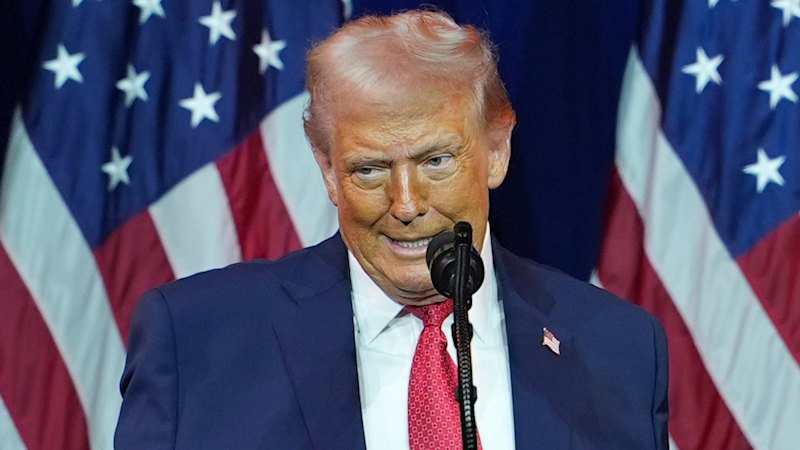
Former President Donald Trump has reignited discussions about Greenland, suggesting that the territory could be a strategic acquisition for the United States. This renewed interest comes as Trump faces significant challenges domestically, including low poll numbers and increasing pressure from political opponents.
Trump’s chief of staff, Susie Wiles, has described him as possessing an “alcoholic’s personality,” indicating a tendency towards compulsive risk-taking. As his political fortunes decline, the allure of foreign policy maneuvers, like the potential annexation of Greenland, becomes more pronounced.
International Dynamics and Domestic Pressures
Historically, U.S. presidents often pivot to foreign policy during challenging domestic situations, a trend that appears relevant to Trump’s current circumstances. Recently, Trump has shown a willingness to operate outside established international norms, as evidenced by his actions regarding Nicolas Maduro in Venezuela. By invoking a U.S. warrant, Trump demonstrated his capacity to leverage military power effectively, raising concerns among international observers, particularly in Denmark.
During a recent appearance, Trump reiterated that “we need” Greenland, dismissing Danish Prime Minister Mette Frederiksen‘s assertion that the idea of U.S. control over the territory is nonsensical. His comments, including a quip about Denmark’s security measures involving “one more dog sled,” illustrate his nonchalant attitude toward the geopolitical implications of such a move.
The U.S. has appointed Jeff Landry, the Republican governor of Louisiana, as a special envoy to Greenland, tasked with exploring possibilities for enhancing U.S. influence in the region. Landry expressed enthusiasm for his role, stating, “It’s an honour to serve you in this volunteer position to make Greenland a part of the U.S.”
The Appeal of Greenland: Strategic and Economic Considerations
Trump’s potential interest in Greenland stems from both strategic and economic motivations. The territory is seen as an attractive option for investment by libertarian entrepreneurs, including Peter Thiel, who have expressed interest in establishing new governance models in less populated areas. Such ambitions align with Trump’s past rhetoric about expanding U.S. territory.
Acquiring Greenland could also shift power dynamics within NATO. Should the U.S. successfully annex the territory, it might provoke a response from Denmark under Article V of the NATO treaty, which stipulates that an attack on one member is an attack on all. The implications of such an action could fundamentally alter the alliance, potentially leaving Denmark without support from its allies.
As Trump navigates his domestic woes, including the prospect of losing control in the House of Representatives following the upcoming elections, he may increasingly resort to foreign policy gambits. The pressure to respond to various legal and political challenges at home could drive him to pursue bold initiatives abroad, including the annexation of Greenland.
The possibility of Greenland becoming a focal point for U.S. foreign policy is not without risks. While Trump may see it as an opportunity for political gain, the actual ramifications of such an action could lead to significant geopolitical tensions. As the situation develops, both domestic and international observers will be closely monitoring Trump’s next moves, weighing the potential consequences of his ambitions.
In a climate where Trump’s political fortunes are shifting, Greenland may offer a tempting distraction and a chance for the former president to assert control in an area where he feels confident. Whether this fixation leads to concrete action remains to be seen, but the prospect of a U.S. presence in Greenland is likely to remain a topic of discussion in the coming months.