



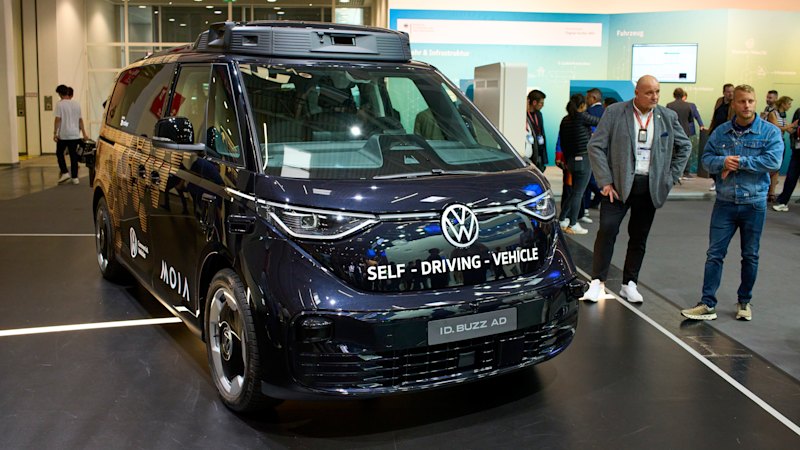
Volkswagen is positioning itself to become the leading player in the self-driving vehicle market, particularly within Europe, as traditional car manufacturers compete to adapt to a rapidly evolving technological landscape. The German automaker plans to launch its autonomous taxi service in Los Angeles in collaboration with Uber later this year, marking a significant step in its strategy to generate new revenue in the autonomous driving sector.
With its dedicated robotaxi unit, MOIA, Volkswagen currently has 100 test vehicles operating across Germany, Norway, and the United States, including 30 in Hamburg. The company is actively negotiating with various European cities to expand its services following the launch in Los Angeles, with an ambitious goal of deploying 100,000 vehicles by 2033.
Strategic Vision for Autonomous Driving
Christian Senger, head of Volkswagen’s autonomous driving division, emphasized the company’s objective to establish itself ahead of its traditional competitors. He stated, “There is a tendency for the market to be an oligopoly where only a few large players will be the most advanced,” adding that Volkswagen’s ambition is for MOIA to become the “European champion” in the robotaxi sector.
Volkswagen’s approach includes a comprehensive business model aimed at local transport operators. This model not only encompasses vehicle leasing but also covers maintenance and training on fleet management software. This strategy differs from other partnerships between automakers and ride-hailing companies, which primarily focus on supplying vehicles.
The company’s specialized fleet of ID. Buzz electric vans relies on a combination of cameras and sensors for navigation. Unlike competitors such as Waymo and Tesla, which have developed their proprietary autonomous technologies, Volkswagen utilizes the expertise of Israeli start-up Mobileye for the “brains” of its vehicles.
According to Senger, Volkswagen anticipates that the commercial vehicle sector for autonomous driving could yield annual revenues exceeding €10 billion (approximately $16.5 billion) within seven years. He noted that the markets for autonomous driving services in the United States and Europe could be valued between €350 billion and €450 billion by 2035.
Challenges and Competitive Landscape
Despite Volkswagen’s aggressive plans, the company faces significant challenges in a market where competitors like Waymo have already gained substantial ground. Waymo has recorded more than 125 million fully autonomous miles on U.S. roads with few safety incidents, while Tesla has focused on integrating artificial intelligence and autonomous features into its vehicles.
Volkswagen’s current testing program has seen its vehicles cover only 1 million kilometers, which places it behind Waymo in terms of distance driven. Nonetheless, the company believes that its familiarity with the European market and mapping data from its existing passenger vehicle fleet provides a competitive edge. A recent test drive in Hamburg demonstrated the autonomous vehicle’s capability to navigate through snowy conditions without human intervention, highlighting Volkswagen’s experience in challenging environments.
Analysts have raised concerns about legacy carmakers, including Volkswagen, keeping pace with advancements made by technology firms in autonomous driving. Patrick Hummel, an analyst at UBS, suggested that traditional manufacturers might struggle to play a significant role in the sector, primarily because they do not directly control the underlying technology.
Volkswagen’s most recent partnership with Uber comes on the heels of the abrupt closure of Argo AI, a self-driving technology group that Volkswagen co-funded with Ford. In contrast, competitors like Mercedes-Benz are also exploring partnerships, including collaborations with Chinese firms to develop luxury robotaxi services.
In a bid to sustain investment in autonomous technology, Volkswagen has signaled its willingness to adjust the ownership structure of its autonomous driving unit. Senger acknowledged the necessity of additional funding to facilitate expansion and achieve profitability, stating, “If you are not able to scale, you will never get to the profits.”
As Volkswagen ventures deeper into the autonomous driving arena, it remains to be seen whether the company can navigate the complexities of a highly competitive market and establish itself as a leader in self-driving technology.