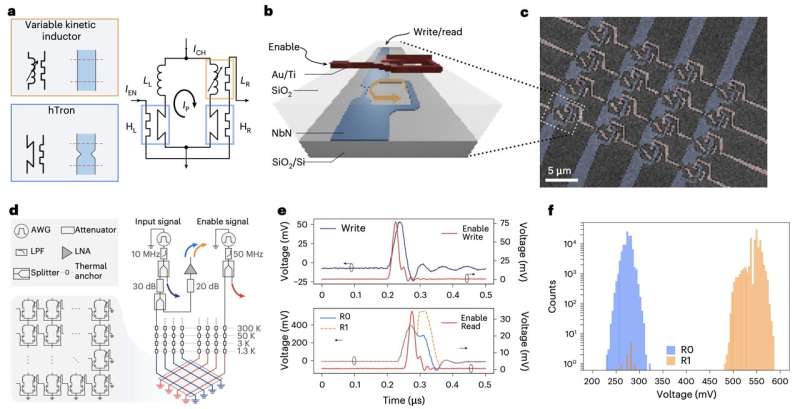
Researchers at the Massachusetts Institute of Technology (MIT) have developed a new superconducting nanowire memory array that significantly reduces error rates, enhancing the potential for efficient quantum computing. This innovative memory system, described in a study published in Nature Electronics on January 25, 2026, represents a key advancement in the search for faster and energy-efficient memory components essential for quantum technologies.
Superconducting memories leverage materials that conduct electricity without resistance at low temperatures. While they promise speed and efficiency, many existing designs struggle with high error rates and scalability. The new superconducting memory array created by MIT researchers focuses on nanowires, which are one-dimensional structures known for their unique optoelectronic properties.
In their research, Owen Medeiros, Matteo Castellani, and their team constructed a compact 4 × 4 superconducting memory array designed for scalable operations. The system boasts a functional density of 2.6 Mbit cm −2, which enhances its application in larger memory systems. The researchers emphasized the importance of scalable memory for creating low-energy superconducting computers and fault-tolerant quantum computers, stating, “Conventional superconducting logic-based memory cells possess a large footprint that limits scaling.”
The memory cells consist of a superconducting nanowire loop featuring two temperature-dependent switches and a variable kinetic inductor. Each cell operates at a temperature of 1.3 K, facilitating stable memory operations. The kinetic inductor plays a crucial role by resisting changes in electrical current, enabling predictable flow and enhancing performance.
To write and read information, the researchers employ precisely timed electrical pulses that temporarily heat one of the nanowire switches, increasing its resistance and allowing magnetic flux to enter the loop. This magnetic flux encodes data values of either 0 or 1. Once the pulse ceases and the nanowire returns to its superconducting state, the information is retained within the loop.
Initial tests of this superconducting memory array have shown promising results, achieving an error rate of approximately 1 in 100,000 operations. This performance marks a significant improvement over many existing superconducting memory systems. The authors noted, “We achieve a minimum bit error rate of 10 −5,” and utilized circuit-level simulations to analyze the memory cell’s dynamics and stability under varying conditions.
The findings from this study could pave the way for the practical application of superconducting memory systems, moving them closer to reliable use in real-world environments. The researchers believe that further enhancements to their design could enable the development of even more robust memory systems in the future.
This advancement in superconducting memory technology not only holds potential for quantum computing but also illustrates the significant strides being made in the field of materials science and engineering. As the demand for faster and more efficient computing systems grows, innovations like the one from MIT may play a crucial role in shaping the future of technology.